Volumetric Flask Class A or Class B: Tolerances by Size
A 10 mL Class A flask is allowed 0.20 % error and a 1 L one 0.03 %. The class letter alone does not tell you whether the flask matters in your method.
Disclosure: We may earn a commission if you purchase through links on this page, at no additional cost to you. Our selection criteria do not depend on commission; see our affiliate disclosure.
Volumetric flasks get bought by size and by price, and the class letter is often the least-read word on the order line. That is a pity, because the letter is the only part of the specification that says how wrong the flask is allowed to be. It is also a cheap decision to get right: the tolerance difference between A and B is a fixed ratio, and the real question is whether your method can see it.
This guide sets out what the two classes mean in ASTM E288, what the tolerances look like by size, where retailer tables contradict each other, and how to check a flask on your own balance. The ASTM E288 scope and notes were read through store previews and excerpts, not the full licensed text, and the ISO 1042 tables were not seen at all. Tolerance values below therefore come from retailer and manufacturer listings, and where those disagree both values are shown.
What the two classes are
ASTM E288 is the specification for laboratory glass volumetric flasks. It covers precision and general-purpose grades. Class A is the precision grade, and each Class A flask must be marked with the letter "A". Class B flasks are the same basic design, but their volumetric tolerance is twice the range allowed for Class A, and they need not carry a class mark. That "twice" is repeated in the Kimble catalogue, in UKAS's guidance on volumetric apparatus, and in Brand's and DWK's product pages, though Brand says "usually twice" and DWK describes B as roughly half the accuracy.
Two details in the standard matter if you buy unusual sizes. A flask of a capacity not listed in the standard can still be called Class A if it meets the tolerance of a listed neighbour. The current edition's store preview says the neighbour is the next largest Class A flask. The preview of the 2006 edition says the next smaller one. It cannot be told from excerpts whether that is a real change or a wording difference, and the two readings give different answers for, say, a 150 mL flask. Wide-mouth flasks have their own table, and their tolerance has to be marked on each Class A wide-mouth flask. Micro flasks from 1 to 25 mL are covered in a separate specification, E237.
Price tiers add a further wrinkle. Kimble's catalogue sorts its glassware into serialised and certified Class A, Class A, Class B, and an economy line, and its comparison table marks the first three as meeting the ASTM tolerance in every case and the economy line as meeting it only in some. If a flask carries no class mark at all, that is a reason to ask the seller what tolerance it was made to, because an unmarked economy flask is not automatically Class B.
Tolerances by size
The numbers below are Class A tolerances as printed on the retailer and manufacturer listings that could be read (Ward's/VWR, Thomas Scientific and Eisco, all ASTM-labelled). Class B figures are simply twice those, which Kimble's catalogue confirms for the 50 mL size at ±0.05 and ±0.10 mL. The last column is each tolerance as a percentage of the nominal volume.
| Nominal volume | Class A | Class B | Class A as % of volume |
|---|---|---|---|
| 10 mL | ±0.02 mL | ±0.04 mL | 0.20 % |
| 25 mL | ±0.03 mL | ±0.06 mL | 0.12 % |
| 50 mL | ±0.05 mL | ±0.10 mL | 0.10 % |
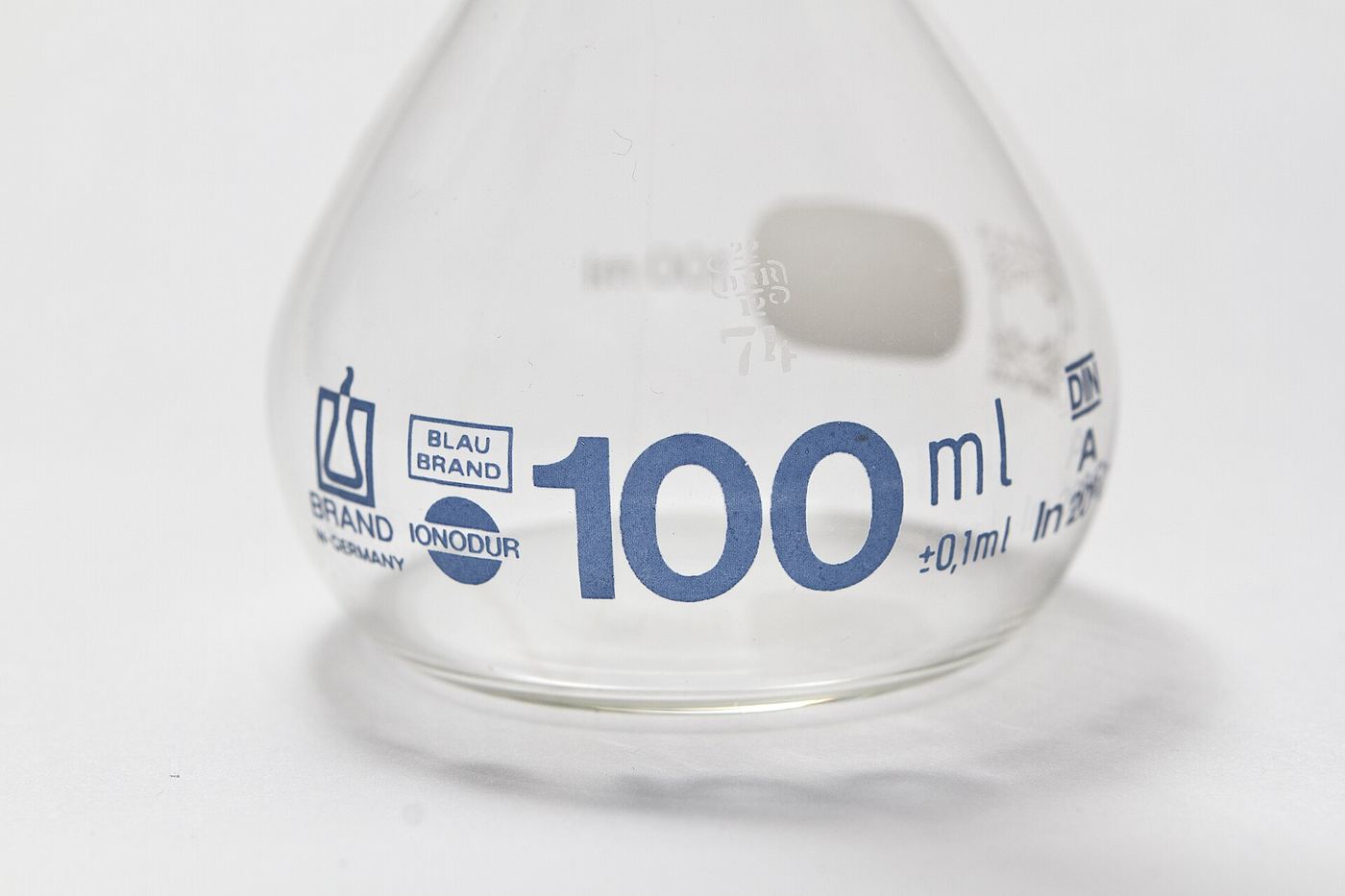
| 100 mL | ±0.08 mL | ±0.16 mL | 0.08 % |
| 250 mL | ±0.12 mL | ±0.24 mL | 0.048 % |
| 500 mL | ±0.20 mL | ±0.40 mL | 0.040 % |
| 1000 mL | ±0.30 mL | ±0.60 mL | 0.030 % |
Thomas also lists 5 mL at ±0.02 mL, 200 mL at ±0.10 mL and 2000 mL at ±0.50 mL.
The percentage column is the useful part. A 10 mL flask is allowed to be ten times worse in relative terms than a 1 L flask, and a Class B 10 mL flask is allowed 0.4 %. If your method needs 0.1 % volumetric accuracy, the small Class A flask is already over the line before anyone touches a pipette.
Where the listings disagree
Three kinds of conflict turned up.
The first is the 10 mL and 25 mL sizes. Eisco's own web store lists a 10 mL Class A flask with a polyethylene stopper at ±0.025 mL and a 25 mL flask with a polypropylene stopper at ±0.04 mL. Eisco's glass-stoppered flasks, sold through Ward's and Genesee, list ±0.020 and ±0.030 mL under the ASTM label. Thomas lists ±0.02 and ±0.03 for both its ASTM-labelled flasks and for a separate line it says conforms with ISO 1042. So one catalogue shows two sets of numbers, and another says the ISO line matches the ASTM one. The ISO table was not seen. Rather than guess which is right, read the tolerance printed on the flask or the certificate and do not assume it from the standard's name.
The second is outright typing errors. One retailer's specification table gives a 10 mL flask as 0.20 mL and a 100 mL flask as 0.80 mL, ten times the same page's headline figures of ±0.020 and ±0.080. A 50 mL flask is listed at 0.50 mL on that page, too. These are misplaced decimals, but anyone who copies a table into a method without checking would carry them along.
The third is a blanket percentage. One guide states Class A is ±0.05 % and Class B ±0.10 %, with no source. That does not fit the tables above, where Class A runs from 0.20 % at 10 mL to 0.03 % at 1 L. The ratio of two is right and the absolute figure is not, so it is not worth using.
Contain, deliver, material and neck
Volumetric flasks are calibrated to contain ("In", or TC): the nominal volume is what the flask holds when the meniscus sits on the mark at 20 °C, not what it pours out. DWK notes that ISO uses "In" for to contain and "Ex" for to deliver, and Vitlab says its plastic flasks are individually calibrated to contain and that, because of the materials' water-repelling surface, contained and delivered volumes are substantially the same in plastic instruments.
Plastic flasks follow a class split by polymer. Vitlab states that PMP (polymethylpentene) is used exclusively for Class A flasks and cylinders because of its transparency and dimensional stability, and polypropylene for Class B. Brand's listing agrees: its PMP flask is available in A or B, its high-clarity PP flask is Class B only. A listing for a 100 mL PMP Class B flask gives ±0.20 mL, which fits neither ±0.16 mL, the double of ±0.08 mL, nor the glass pattern. It may be a different tolerance base or a rounded figure, and the listing does not say.
Amber glass carries the same class system. DWK prints Class A in blue on clear glass and in white on amber, and Class B in white. Wide-neck flasks are allowed a larger tolerance. Brand says ISO 1042 requires them to be marked "W", and Kimble's table shows a 50 mL wide-mouth flask at ±0.08 mL against ±0.05 mL for the standard neck.
Reading the tolerance as part of an error budget
A tolerance is a limit on error, not an expected error. An uncertainty paper, readable only as a copy on a document site, makes the point that a manufacturer's tolerance already includes the random error of ordinary use, so it should not be stacked with a separate reading error for the same flask. Its full citation could not be identified, so this is treated as a reasoned position rather than an authority.
Here is where the flask sits among other errors, with arithmetic that is arithmetic and not a claim. Say you weigh 10 mg of standard on a balance reading to 0.1 mg and dissolve it in a 100 mL flask. One reading step of 0.1 mg is 1 % of 10 mg. The Class A flask contributes up to 0.08 %, and a Class B flask 0.16 %. The weighing term is six to twelve times larger than the flask term. Upgrading from B to A there improves almost nothing; weighing 100 mg instead of 10 mg would improve the result ten times more.
The picture changes with a dilution chain. Three successive dilutions in 10 mL Class B flasks, each allowed 0.4 %, can pile up to 1.2 % in the worst case, or about 0.7 % if the errors are treated as independent and combined in quadrature. The same chain in Class A flasks gives 0.6 % worst case and about 0.35 % in quadrature. Here the class matters, and a larger final flask would matter more.
Even then the flask may not be the weak link. Kimble's table gives a Class A 5 mL volumetric pipet as ±0.01 mL, which is 0.2 %. Put that 5 mL into a 100 mL Class A flask for a 1:20 dilution and the pipet brings 0.2 % while the flask brings 0.08 %. They add to 0.28 % at worst and about 0.22 % in quadrature. Swap in a Class B flask (0.16 %) and the quadrature figure barely moves, to roughly 0.26 %. Treating a tolerance limit as a standard deviation is crude, but the exercise tells you which glassware to upgrade first, and here it is the pipet.
The rules that follow are judgment, not published guidance. Use Class A for anything that makes a calibration standard or a quantitative stock. Use Class B for rough dilutions, teaching, and solutions whose concentration never becomes a result. And at the small end, think twice before choosing 10 mL when a 25 or 50 mL flask would give a lower relative tolerance for only a little more material.
Equipvia may earn a commission from qualifying purchases through this link. The link resolved to Product ID 1601038256996 during review. CPS resolution does not verify the seller's technical claims, the class, affiliate eligibility, or commission attribution. Check the actual selected variant and current terms before ordering.
For a flask the number to insist on is the one that will be printed on the piece: at 1 L, Class A is ±0.30 mL under E288 and the certificate should state the measured value inside that. Ask whether the certificate quotes ASTM E288 or ISO 1042, since the two are not identical and the article above shows a catalogue that claims they match at small sizes. And check the neck and stopper: a wide-neck flask has a looser tolerance by design, and a stopper that does not seat is a bigger error than any class difference.
Heat, cleaning and plastic
The handling limits in this section all come from sellers. Brand says its glass volumetric ware should be cleaned at no more than 95 °C, and that frequent autoclaving at 121 °C wears down the splinter protection on its coated glassware. One reseller of PMP flasks says 121 °C autoclaving does not permanently push the flask past its tolerance. No independent test of how far a flask's volume moves after repeated heating turned up, so both statements stay with their makers.
Checking a flask on your own balance
ASTM E542 and ISO 4787 cover the calibration of volumetric flasks, and NIST's SOP 14 is the gravimetric procedure for volumetric ware on an electronic balance. The idea is the same in all three. Weigh the water the flask contains, convert that mass to a volume using the water's density at the measured temperature, and refer the result to 20 °C. EURAMET's flask comparison report uses the same equation, with terms for air density, the density of the weights, and the flask's thermal expansion.
NIST is strict about conditions. SOP 14 asks for 20 to 23 °C with the set point held within ±2 °C and drift of no more than 1 °C per hour, relative humidity of 40 to 60 %, a water thermometer good to ±0.1 °C, and weights of ASTM Class 2 or 3. If the water temperature moves by more than 0.2 °C between readings, the procedure sends you back to refill and reweigh. NIST's water guidance adds that temperature accuracy matters as much as purity when you take the density, and that ASTM Type III or IV reagent water is adequate for this work.
A bench check can be much looser. Water is close to 1 g/mL, so a Class A 100 mL flask allowed ±0.08 mL should hold the expected mass of water to within about ±0.08 g. Seeing a deviation that small takes a balance reading to 0.01 g or better and a temperature good enough to pick the right density. Screening like this will not replace a certificate, but it should expose a flask that is plainly wrong, such as one that was mislabelled.
What this article could not check
The ISO 1042 tables and the ASTM E288 tables themselves were never read, only retailer reproductions, and those have been shown to contain inconsistencies. The figures here are only as good as the listings. Before a flask size and class goes into a method, read the tolerance on the flask or its certificate.
Share this article