Magnetic Stir Bar Size by Flask Volume, and When to Retire One
Used PTFE bars have been found carrying palladium, platinum and iron in surface cracks, and a catalyst-free reaction stirred with one produced conversion.
Disclosure: We may earn a commission if you purchase through links on this page, at no additional cost to you. Our selection criteria do not depend on commission; see our affiliate disclosure.
A stir bar costs a few dollars. That is exactly why nobody thinks about it until a reaction stalls, a bar skitters across the plate like a startled insect, or a catalysis result will not repeat. Then it turns out that three small choices were made on autopilot: how long the bar is, what it is made of, and how many months it has been in the drawer.
This guide walks through those choices in the order you meet them when reordering. For sizing it leans on the vendors' own selection pages (Fisher Scientific, Sigma-Aldrich/Merck, Radleys, Asynt, BRAND, Cowie). For the questions where plain marketing runs out, it uses two papers from Valentine Ananikov's group, a 2019 study in ACS Catalysis and a 2025 study in JACS Au, plus a clinical reference on PTFE fumes. Where the sources disagree both positions are shown, and where a sentence is judgment it is labelled as such.
Sizing: three rules that do not quite agree
Start with the shortest rule, because every vendor gives it. The bar has to be small enough not to touch the vessel wall while it turns. Sigma-Aldrich adds the other half: within that limit, bigger is better, because a larger bar moves more liquid.
Past that, the advice splits.
Fisher Scientific's selection guide ties the bar to the stirrer. The length should be about equal to the internal drive magnet, because a bar that is too long or too short for it couples badly and spins out at a lower speed. Another Fisher page gives a different rule: bar length at about two thirds of the diameter of the vessel floor. A third seller, ConductScience, gives two thirds of the container diameter for its 125 mm plate. Those two rules are not the same rule. One is about the stirrer, the other about the flask, and a flask on a small stirrer can satisfy one and break the other.
A workable order, which is judgment and not published: take the flask rule first, since it decides whether the bar fits and circulates, then check the stirrer. If the bar turns out far longer than the drive magnet, expect a lower top speed. Fisher says as much, and a manufacturer's spec sheet may state a maximum bar length.
Some worked numbers. A beaker with a floor roughly 50 mm across gives about 33 mm by the two-thirds rule, so a 30 mm bar is a sensible pick. That is arithmetic, not a catalogue value.
Round-bottom flasks break the rule on purpose. Fisher notes that a round-bottomed flask needs a smaller bar even when its widest diameter is large, since the bar can catch on the curved wall near the bottom. Sigma-Aldrich says the same about curved vessels.
Vendors that sell flask-specific pairings are a useful cross-check. Asynt lists a 15 mm oval PTFE bar for 10 mL flasks, 25 mm for 25 and 50 mL, and 30 mm for 100 to 500 mL. Radleys recommends a 25 mm elliptical bar for 100 to 500 mL flasks on its StarFish and for 100, 170 and 250 mL flasks on a Carousel 6 Plus, and says a 15 mm bar would also work with 25 and 50 mL flasks. Look at the overlap: both vendors land at 25 to 30 mm for the 100 to 250 mL class. Treat those as starting points for their own heating blocks, though, not as universal truth.
Two small habits help whatever the size. Fisher recommends a thin-bottomed vessel, which shortens the gap between bar and drive magnet, and centring both the vessel on the plate and the bar in the vessel.
Shape: match the bar to the bottom of the vessel
Shape matters less than size, but a wrong shape wastes the right size.
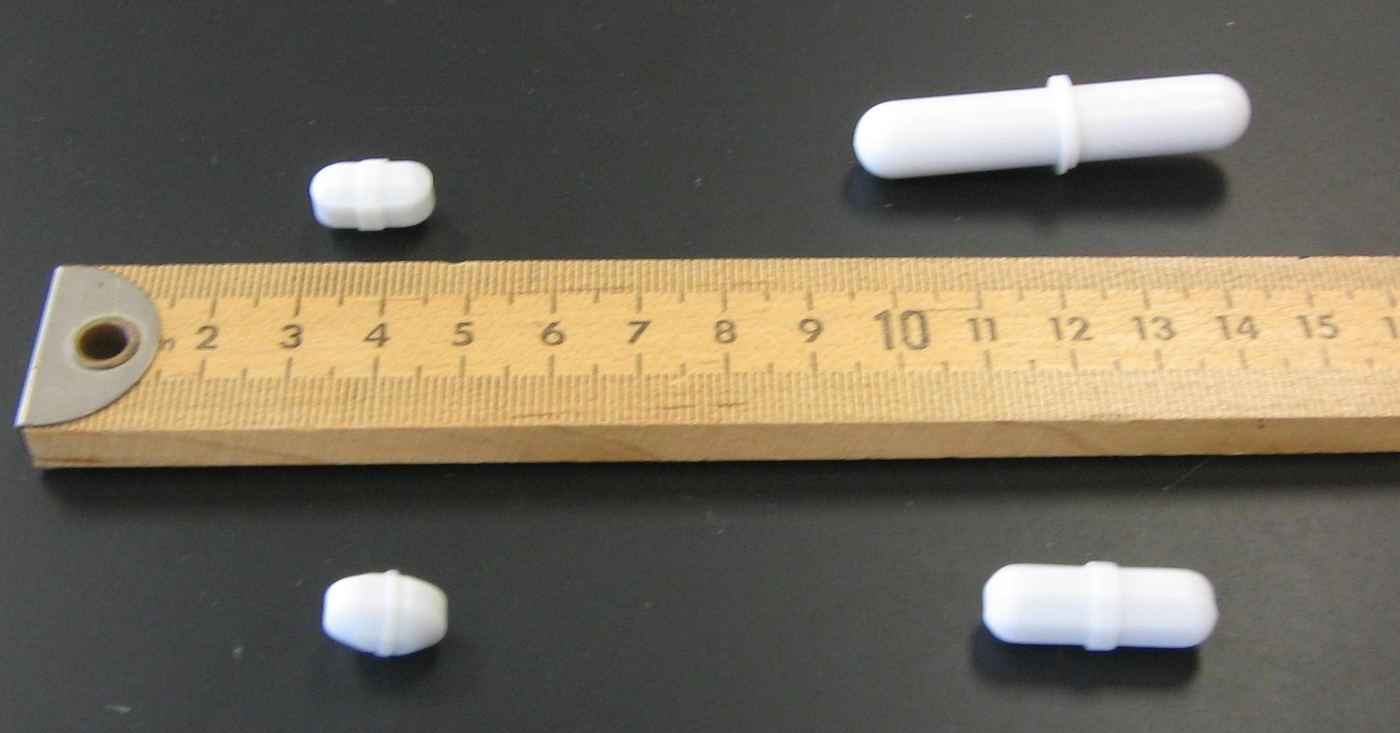
Sigma-Aldrich pairs them like this. Plain cylindrical bars go in flat-bottomed beakers. Cylinders with a pivot ring suit curved or uneven bottoms, and the ring cuts friction. Spherical bars are for tubes and vials. Triangular bars scrape the bottom and prevent sediment, and bring more turbulence when you need it. Crown-shaped bars fit cuvettes and test tubes, and bone-shaped bars sit well in slightly convex bottoms. Cowie also sells a disc-shaped bar for tube-like containers.
The pivot ring has a second job that gets less attention. BRAND points out that rough vessel surfaces or abrasive sediment wear PTFE quickly, and that a bar with a reduced contact surface, such as one with a centre ring, lasts longer. So the ring is partly a consumable-life feature.
Radleys adds a caution worth taking seriously. Solids and crystals can get ground between the bar and the glass, and in that case it advises an overhead stirrer instead. One step further, and this is judgment: if you already expect a thick slurry, a bigger bar is the wrong fix.
What is inside the bar, and what is on it
A stir bar is a magnet in a jacket. Two choices, then.
The magnet. Cowie says Alnico V is the usual core, with samarium-cobalt, neodymium and metal oxides less common. It ranks strength as neodymium, then samarium-cobalt, then Alnico, then metal oxides, though it warns that a stronger magnet does not automatically mix better. Sigma-Aldrich and Fisher both say samarium-cobalt bars couple more strongly to the drive magnet and reduce spin-out. Radleys says its rare-earth bars can be recognised by a black spot or "RE" in the name, and that they help with viscous samples.
There is a catch with neodymium. Cowie states that it cannot be encapsulated directly in PTFE, because PTFE processing temperatures exceed neodymium's 150 °C working maximum. If a vendor sells a neodymium bar, ask about the jacket and the temperature rating before you put it on a hot plate.
Cowie also notes that a powerful rare-earth core can increase particle generation by grinding against the container base. So the strongest bar is not always the cleanest.
The jacket. PTFE is the default. Polypropylene is cheaper but, per Cowie, has lower chemical resistance and works only to 120 to 130 °C. Glass is the choice for very high temperatures or where PTFE is incompatible, with the risk of breakage and abrasion against glass containers.
How hot is too hot? The numbers disagree
This is the question that most wanted a clean answer, and did not get one.
For PTFE-jacketed bars with Alnico or samarium-cobalt cores, Cowie gives 260 °C and for glass 274 °C. BRAND gives 270 °C for its PTFE bars. The Thomas Scientific listing for a PTFE octagonal bar says 225 °C on one page and 250 °C on another, and a Fisher listing of the same Heathrow Scientific bar carries both figures in a single description. Cowie's disc-shaped bar is quoted from minus 200 up to 260 °C.
So the same material, in the same shape, is rated anywhere from 225 to 270 °C. The sensible reading is that the rating is a vendor decision and depends on the core, the weld, and how much margin the maker wants.
The safety angle comes from a clinical reference. The NCBI StatPearls entry on polymer fume fever says PTFE can release fumes at temperatures as low as 260 °C, that symptoms generally begin at around 350 °C, and that pyrolysis starts at 400 °C. It is not a stir-bar document, and it describes inhalation incidents, so take it as context and not as a design limit.
A working rule, unpublished: set the limit from the lowest figure you can find for the exact bar you bought, then subtract a margin for the difference between the bath and the glass. Remember also that a hot-plate surface can sit well above the liquid temperature you read. Cowie adds that heating a magnet above its Curie temperature demagnetises it, though it gives no numbers, so none are given here.
Spin-out, stalling and why the position on the plate matters
A bar that jumps and rattles is usually decoupling. The cause is rarely the bar alone.
A US patent describing a stirrer coupling (US 10,695,730) says high start-up inertia, meaning a big step in rotational speed, is the main cause of uncoupling, and that basic lab stirrers are typically rated to about 1,000 to 1,200 rpm without a speed ramp. A patent is an inventor's argument for their own design, so it reads as a hypothesis. It does match the advice that Cowie and Labsup both give: raise the speed slowly.
Cowie adds an odd remedy for the opposite problem. A very strong interaction can brake the motor and prevent rotation, and lifting the vessel 1 to 3 cm above the drive may allow effective stirring. It also warns that pulling a bar out while the drive is still turning can demagnetise it.
Then there is the issue of where on the plate the flask sits. Cherepanova, Gordeev and Ananikov (JACS Au, 2025) ran identical reactions in vials placed at different positions on the same stirrer. The paper's abstract and a Chemistry World summary describe bar rotation that changes with position and stops entirely at certain spots. According to Chemistry World, identical Suzuki-Miyaura reactions differed by 10 to 20 % or more in conversion, and misaligned bars gave more than a two-fold difference in nanoparticle size. The full text was blocked, so the numbers rest on the abstract and that report.
The practical advice from the authors is cheap. Put an important reaction in the centre of the plate, check the bar's motion by eye, and record the stirrer model, bar type and size, speed and vessel in your notes.
Equipvia may earn a commission from qualifying purchases through this link. The link resolved to Product ID 62252815607 during review. CPS resolution does not verify the seller's technical claims, the magnet grade, affiliate eligibility, or commission attribution. Check the actual selected variant and current terms before ordering.
A mixed pack solves the wrong problem if you never measure anything. What matters when ordering is a bar whose length you can match to the vessel floor and the drive magnet, so ask the seller for the actual millimetre lengths in the pack rather than the piece count, and for the magnet material, since Alnico, samarium-cobalt and neodymium behave differently on viscosity, spin-out and temperature. For trace-metal work the pack has a second use: it is cheap enough to dedicate individual bars to individual reactions and label them, which is the practice the last section argues for.
When to replace a bar
Vendors say a bar lasts indefinitely. Cowie calls the shelf life indefinite under normal use and storage. Storage is the fine print: ambient temperature, bars stored in pairs rather than loose, kept off steel and iron, and away from other magnets. BRAND adds do not drop them on hard surfaces.
Use is a different matter. Pentsak, Eremin, Gordeev and Ananikov (ACS Catalysis, 2019) examined used PTFE bars under an electron microscope. They found microscale cracks and defects, and metal contamination including palladium, platinum, gold, iron, cobalt and chromium. In a Suzuki-Miyaura test, a catalyst-free reaction with a used bar produced real conversion. The same reaction with a new bar produced none.
How many bars? Here two reports disagree. C&EN and the press release describe 60 used bars from labs in the institute, only one free of contamination. Chemistry World says the team surveyed over a hundred. It cannot be told from the secondary reports whether the larger number covers a wider survey, and the paper's own count was not seen. The qualitative finding is the same either way.
C&EN adds that significant damage can appear within weeks, and the authors' calculations suggest damaged PTFE grips metal particles more strongly than pristine PTFE. The press materials say routine cleaning did not remove the contamination. C&EN adds that one outside group strips palladium from its bars with aqua regia, while many chemists only scrub and rinse with acetone and water.
What does this mean at the bench? Here is a rule of thumb, and it is not a standard:
- For trace-metal catalysis or ultra-trace analysis, use a new bar, or a bar dedicated to one chemistry, labelled.
- Retire a bar that has changed colour, shows scratches, or rattles in the jacket.
- Never move a bar between catalysis work and a clean aqueous prep.
- For ordinary buffers and salts, a bar can last for years, and there is no reason to throw it away on a schedule.
Thomas Scientific sells a pack of bars as "contamination-free stirring" at a price that, in its words, justifies single use. That is sales copy, but the arithmetic is fair when a failed batch costs more than a pack.
A short reorder routine
None of this is a published procedure.
Measure the floor of your most-used vessel and the drive magnet of your stirrer before ordering. Buy one length that fits both, and a smaller one for round-bottom flasks. Pick PTFE with an Alnico core unless you stir viscous liquids, in which case look at samarium-cobalt. Add a pivot-ring version if you stir on rough or curved surfaces. Check the temperature rating on the exact product page, because the same bar may carry two. Buy a retriever too, because fishing a bar out of a flask with a spatula is how bars get dropped. Thomas lists a 300 mm PTFE one.
What this article could not check
No bar was tested, and every vendor number here comes from a seller's page. The JACS Au paper was read only through its abstract and press coverage, because the full text was blocked. The ACS Catalysis paper was read through its abstract and several secondary reports, so the count of bars is uncertain. The StatPearls entry is a clinical reference for polymer fume fever, not a lab-safety standard.
Share this article