Stir Bar Coatings and Cores: PTFE, Glass, Polypropylene and the 260 °C Limit
The same PTFE coating is rated 225 °C by one vendor, 260 °C by another and 290 °C in a coatings table. The span is 65 K for one material.
Disclosure: We may earn a commission if you purchase through links on this page, at no additional cost to you. Our selection criteria do not depend on commission; see our affiliate disclosure.
Cowie Technology gives a maximum working temperature of 260 °C for a PTFE-coated stir bar with an Alnico or samarium cobalt core, 274 °C for glass and 120 to 130 °C for polypropylene. Bel-Art says glass is the choice above 225 °C because PTFE is not stable there. The plastech coatings table, which reproduces Chemours data, lists PTFE at 290 °C continuous, while the Teflon industrial coatings page from Chemours lists 260 °C. The span between those PTFE figures is 30 K. A separate question is wear: in a 2019 ACS Catalysis study, 59 of 60 used stir bars from different laboratories carried metal contamination.
Coating limits by source
All values are in °C. The first three rows are stir bar vendors. The last two rows are Teflon coating data, which describe sprayed or baked coatings and not moulded stir bar jackets, so they are context and not a stir bar rating.
| Source | PTFE | Glass | Polypropylene |
|---|---|---|---|
| Cowie technical sheet (issued 01/04/2025) | 260 | 274 | 120–130 |
| Cowie octahedral PTFE bar page | −200 to 260 | – | – |
| Bel-Art selection guide | not stable above 225 | recommended above 225 | – |
| Fisher Scientific listing | – | up to 274 | – |
| Chemours coatings page | 260 continuous, 316 intermittent in text; 500 °F and 550 °F in the table | – | – |
| plastech coatings table (Chemours data) | 290 continuous, 315 intermittent | – | – |
Chemours' coatings page gives 316 °C intermittent in the text (600 °F) and 550 °F for PTFE in the table, which is 288 °C. plastech gives 315 °C (600 °F). The glass-over-PTFE crossover sits at 225 °C in Bel-Art and at 260 °C in Cowie, a difference of 35 K. Glass at 274 °C minus Cowie's 260 °C is 14 K; glass at 274 °C minus Bel-Art's 225 °C is 49 K.
The melting point of PTFE is 327 °C (621 °F) in the plastech table under ASTM D3418, and 627 °F (330.6 °C) in the Chemours table. The distance from 260 °C to 327 °C is 67 K. A vendor FAQ says PTFE starts to degrade above 260 °C and that fumes above 350 °C can cause polymer fume fever. A wiki-derived summary puts the start of decomposition at 260 to 350 °C and pyrolysis above 400 °C. The start of decomposition is therefore given either as 260 °C or as a 90 K window from 260 to 350 °C.
Polypropylene at Cowie is 120 to 130 °C, which is 248 to 266 °F and 130 K under PTFE at 260 °C. Cowie also notes its weaker resistance to hydrocarbons.
What the jacket does when it heats
PTFE linear expansion is 112 to 125 × 10⁻⁶ per K in a reference-table summary and 100 to 160 × 10⁻⁶ per K at a vendor table. A rise from 25 to 260 °C is 235 K, so strain works out at 2.63 to 2.94 percent from the first range and 2.35 to 3.76 percent from the second. On a 10 mm diameter that is 0.26 to 0.29 mm; on a 50 mm length it is 1.32 to 1.47 mm. A jacket and its core expanding at different rates is the mechanism behind a bar that rattles after a few hot plates, though no source read here states that limit directly.
Magnet core: Alnico, samarium cobalt and neodymium
Cowie states that Alnico V is the most commonly used core, with samarium cobalt and neodymium less common. Fisher lists its pivot ring PTFE bars with an Alnico V core. Two figures matter for a heated stirrer: the maximum operating temperature, above which loss is permanent, and the Curie temperature, above which magnetism disappears. SDM Magnets defines the first as the point where irreversible flux loss does not exceed 5 percent.
| Core | Max operating, °C | Curie, °C | Source |
|---|---|---|---|
| Alnico 5 (cast) | 550 | 850 | Raw Materials Comparison Chart |
| Alnico 5 (sintered) | 450 | 860 | same chart |
| Alnico (range) | 450–550 | 800–860 | Stanford Magnets |
| Alnico | 550 | 750–850 | SDM Magnets |
| SmCo5 (1:5) | 250–300 | 720 | Stanford Magnets |
| SmCo5 (1:5) | 200 | 700–750 | SDM Magnets |
| SmCo5 / Sm2Co17 | 250 / 350 | 720 / 820 | Radial Magnets |
| Sm2Co17 | 350–550 | 800 | Stanford Magnets, second table |
| Sm2Co17 | 250–550 | 800–850 | SDM Magnets |
| Neodymium, N grade | 80 | 310–350 | SDM Magnets |
| Neodymium 52 | 80 | 312 | Raw Materials Comparison Chart |
Stanford Magnets prints two different Sm2Co17 ranges, 300 to 350 °C in one table and 350 to 550 °C in another. Arnold Magnetic Technologies gives 750 °C for the 1:5 Curie temperature against 720 °C at Stanford and Radial, a gap of 30 K. The Alnico Curie range, 750 to 860 °C, spans 110 K.
Against a 260 °C PTFE jacket: the lowest SmCo5 rating of 200 °C is 60 K under it, the lowest cast Alnico rating of 450 °C is 190 K over it, and a standard neodymium grade at 80 °C is 180 K under it. Cowie adds that neodymium cannot be PTFE-encapsulated directly because PTFE processing temperature exceeds the neodymium maximum working temperature of 150 °C. The plastech coating cure range of 380 to 430 °C sits 68 to 118 K above the 312 °C neodymium Curie figure.
Bel-Art reports up to three times stronger coupling for samarium cobalt than for Alnico, from tests on 1/2 inch by 3/8 inch bars (12.7 × 9.5 mm). That is a vendor claim for one size, and the viscous-fluid curves behind it are in a flyer that was not available in full.
Size, shape and pivot ring
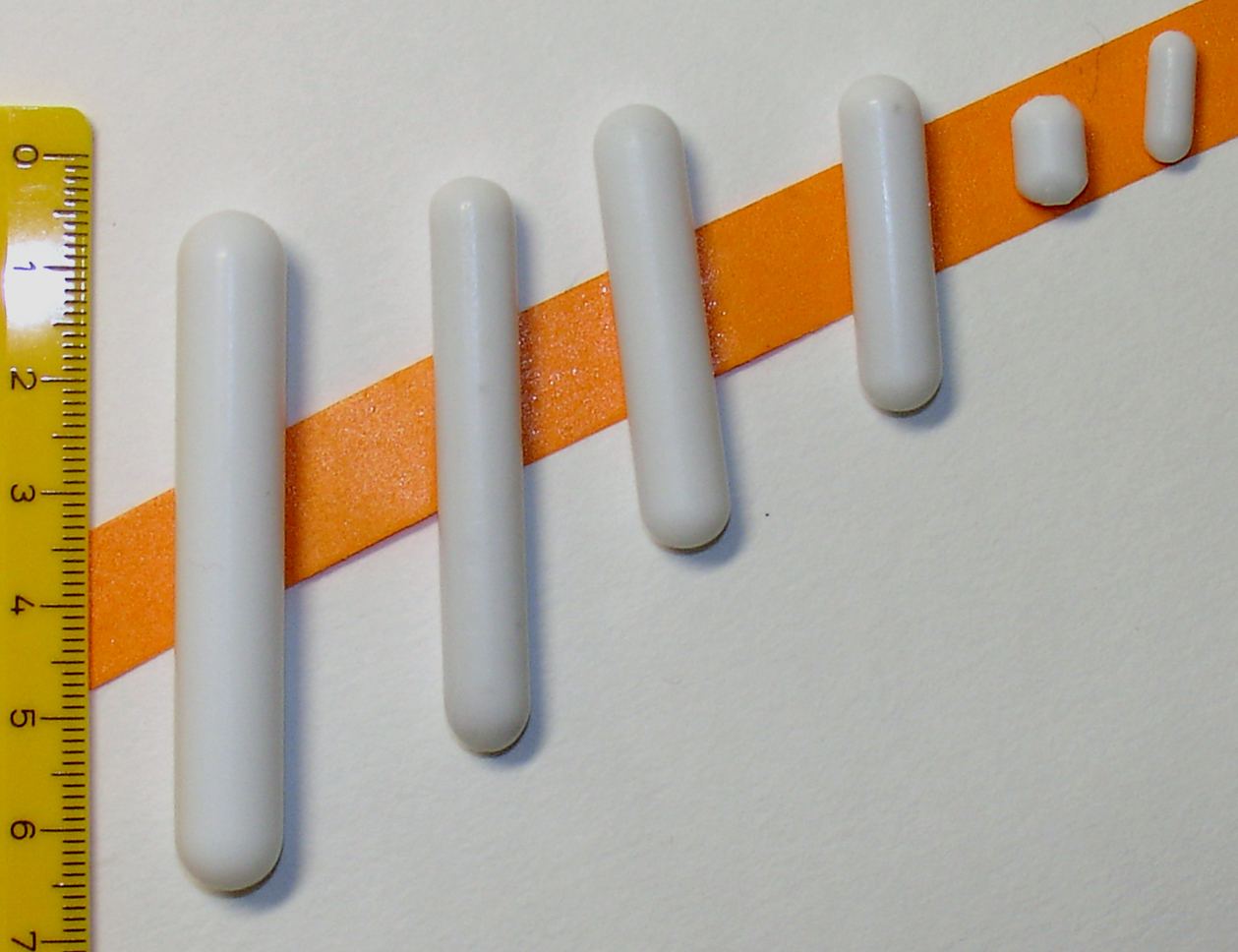
Fisher lists stir bars from 2 × 2 mm to 159 × 27 mm, a length ratio of 79.5 and a diameter ratio of 13.5. The Fisher selection guide says bar length should about equal the drive magnet size to avoid spin-out, and Bel-Art says the distance between the poles of the drive magnet and the bar length should be equal. Bel-Art also says the vertical gap between drive magnet and bar should be minimal, so the vessel base should be thin. Cowie says that after contact with a strong adverse field, raising the vessel 1 to 3 cm above the drive may restore stirring.
Length-to-diameter ratios and volumes of cylinders, from catalogue sizes:
| Listing | Size, mm | L/D | Volume, mL |
|---|---|---|---|
| Thomas SB0515 | 15 × 5 | 3.00 | 0.30 |
| Thomas SB0620 | 20 × 6 | 3.33 | 0.57 |
| Thomas SB0835 | 35 × 8 | 4.38 | 1.76 |
| Synthware SB1050 | 50 × 10 | 5.00 | 3.93 |
| Synthware SB1255 | 55 × 12 | 4.58 | 6.22 |
| Thomas SB1485 | 85 × 14 | 6.07 | 13.09 |
| Fisher removable-ring round bar | 25.4 × 9.5 | 2.67 | 1.80 |
Thomas and Fisher list sizes as diameter times length in some entries and length times diameter in others, so each row was read from the listing text. The L/D span from 2.67 to 6.07 is a factor of 2.3.
The sources split on pivot rings. Fisher's Synthware listings say the pivot ring bars are only for flat-bottom flasks. The Fisher selection guide and the Fisher Ireland page say a pivot ring helps in vessels with curved or uneven bottoms, Cowie says the same, and the selection guide adds that a round-bottom flask needs a smaller bar even when its widest diameter is large. That is two sources for flat only, both Synthware listings from one supplier, and three for uneven bases. Fisher's removable-ring bar page says the ring reduces contact with the vessel and marring of plastic, and that the two smallest sizes, catalogue numbers 14-512-140 and 14-512-141, have no ring.
Equipvia may earn a commission from qualifying purchases through this link. The link resolved to Product ID 1600551858230 during review. CPS resolution does not verify the seller's technical claims, the core type, affiliate eligibility, or commission attribution. Check the actual selected variant and current terms before ordering.
The listing calls the bars both polygonal and cylindrical, and that matters here because the two behave differently: an octagonal bar scrapes and agitates, a cylinder is gentler on the vessel. The pivot ring is the other thing to confirm per size, since the sources disagree about whether it belongs on flat bottoms or curved ones, and the ring is what keeps the bar from grinding the glass. Ask which core the bar carries, because Alnico and samarium cobalt differ by 190 K of margin against a 260 °C jacket, and ask for the jacket temperature on the exact size rather than the family sheet.
Wear, contamination and reactivity
Pentsak, Eremin, Gordeev and Ananikov (ACS Catalysis, 2019) examined used PTFE-coated bars by scanning electron microscopy. Most summaries say 60 bars from different laboratories, 1 of them uncontaminated: 59 of 60, or 98.3 percent. Chemistry World says the team studied over a hundred samples. The count differs between secondary reports, and the paper itself was read through summaries. Metals found include palladium, platinum, gold, iron, cobalt and chromium. A press release says almost all bars in a catalysis lab are permanently contaminated after about a week. ChemistryViews reports palladium on a new bar after a single use, and C&EN reports significant damage within weeks. The authors recommend a control experiment with an unused bar.
Cowie notes that PTFE is soft and can generate particles by wear against the container, with the extent set by surface finish, encapsulation material, core type, vessel material, speed, viscosity, temperature and suspended solids. It positions glass-covered bars for very abrasive media that may erode PTFE, and states that glass carries breakage risk and more abrasion inside glass containers.
Two smaller reports extend the same point. ACS Omega 2019, volume 4, issue 3, page 5098, describes 1 reagent system (lithium in an ammonia-based solvent), 1 colour change (white to black) and 1 fix (glass-coated bars). A ChemRxiv 2021 preprint, not peer reviewed, proposes 2 bar conditions (new and used), 1 digestion method (microwave acid), 1 practice (a blank per vessel) and 1 extra washing step.
Fahrenheit equivalents and the autoclave check
The limits above in Fahrenheit are 500 °F (260 °C), 525 °F (274 °C), 437 °F (225 °C), 554 °F (290 °C), 248 to 266 °F (120 to 130 °C) and 621 °F (327 °C). Fisher lists its PTFE bars as autoclavable. A standard autoclave cycle at 121 °C is 250 °F, which sits 139 K under the Cowie PTFE limit and 1 K above the low end of the Cowie polypropylene range of 120 to 130 °C. The 121 °C cycle therefore falls inside the polypropylene range, and no vendor statement on polypropylene bars in an autoclave turned up.
Cowie describes its PTFE as virgin grade conforming to FDA and USP Class VI. Bel-Art describes its jackets as FDA grade, USP Class VI Teflon, with manufacture in an ISO 9001:2015 facility verified by SGS. Both statements are vendor claims, and the certificates were not seen.
Bel-Art samarium cobalt sizes, and a printing conflict
Bel-Art lists four samarium cobalt octagon bars: F37102-1238 at 1/2 × 3/8 inch (13 × 9.5 mm), F37102-0138 at 1 × 3/8 inch (25.4 × 9.5 mm), F37102-0238 at 2 × 3/8 inch (51 × 9.5 mm) and F37102-0003 at 3 × 1/2 inch. The last size is printed as 76 × 130 mm in one flyer and 7.60 × 1.30 cm in another. The second is consistent with 3 × 1/2 inch, since 3 inches is 76.2 mm and 1/2 inch is 12.7 mm, and the first looks like a decimal slip. The length-to-diameter ratios are 1.37, 2.67, 5.37 and 5.85. The test size of 1/2 × 3/8 inch is the shortest bar in the series and has the lowest ratio, which is worth remembering when a threefold coupling claim is applied to a longer bar.
Listed prices in one catalogue
Globe Scientific lists PTFE pivot ring bars in bags of 2: 12 mm at $10.53, 15 mm at $10.53, 20 mm at $11.15, 25 mm at $13.21, 35 mm at $14.14, 40 mm at $17.44, 45 mm at $18.06, 50 mm at $19.81, 60 mm at $21.67 and 70 mm at $26.52. The 30 mm entry is listed at $27.45, which breaks the pattern. Per bar that is $5.27 for 12 mm and $13.26 for 70 mm, a ratio of 2.52 for a length ratio of 5.83, and $13.73 per bar at 30 mm. These are list prices on the page read, and they change.
What this article could not check
No stir bar rating tested to a published standard was found, nor a spin-out speed by viscosity for each bar size, nor an independent test of the threefold samarium cobalt claim. The Pentsak and ACS Omega papers were read through summaries, so the sample count remains uncertain. Magnet temperature figures come from magnet suppliers, not from a standard. The Bel-Art flyer behind the coupling curves was not available in full.
Share this article