UV-Vis Cuvettes: Quartz, Glass or Plastic, and Which Path Length
At 280 nm, UV-grade quartz passes 88% of the light and optical glass passes 5%. The band that nucleic acid work depends on sits on the wrong side of that cliff.
Disclosure: We may earn a commission if you purchase through links on this page, at no additional cost to you. Our selection criteria do not depend on commission; see our affiliate disclosure.
A cuvette looks like a container, so people buy it like one. Mettler Toledo's cuvette page is blunt about this: the cuvette is part of the spectrophotometer's optical system. Its material absorbs light at some wavelengths, its path length goes straight into the Beer-Lambert equation, and its scratches scatter light into the detector. Pick badly and you can get a clean-looking number that has nothing to do with your sample.
This guide covers the three decisions that matter when you order: material, path length, and how tightly the cells need to match. It also sorts out where vendor claims and the pharmacopoeias agree and where they do not.
Material: it is a wavelength question first
The cutoff is the wavelength below which the cell itself absorbs about as much as your sample can. Measure down there and you are reading the cuvette.
Vendors quote cutoffs differently, which makes buying from a table risky. These are the ranges found for this article:
- Optical glass: 320–340 nm in different articles from one supplier, 350 nm in one of its guides, and 360 nm in another seller's table.
- Polystyrene: about 340 nm in one table, 380 nm in another and in a biology summary.
- PMMA: about 290 nm in one table and 350–380 nm elsewhere.
- Quartz (fused silica): roughly 185–190 nm for the deep-UV grade, 220 nm for the standard UV grade, and 260 nm for the infrared-optimised grade.
Some of this spread is real, since the definition of "cutoff" varies. One supplier defines it as where transmission falls below 50% on a 10 mm path, and notes that stricter criteria such as 80% or 90% push the number up by 5–15 nm. Some catalogues quote the wavelength where transmission reaches 70% instead. Some is lot-to-lot difference in the plastic. The practical lesson is to leave margin: if the sample band you care about sits within 20–30 nm of a quoted cutoff, do not trust the margin.
One seller publishes a transmission table that makes the point bluntly: at 280 nm, UV-grade quartz passes 88% and optical glass 5%. Treat the exact figures as one vendor's data, but the shape is right. The drop from glass to quartz is steep, and the 260 and 280 nm bands that nucleic-acid and protein work live in sit right on the wrong side of it.
Quartz grades
"Quartz" is not one product. JGS1, JGS2 and JGS3 are the Chinese national-standard names for optical-grade fused silica: JGS1 reaches deep UV, JGS2 is the standard UV-Vis grade, and JGS3 is the infrared grade with poor UV performance. One seller of JGS1 argues that JGS1 covers every analytical wavelength you will ever need, which reads as marketing. The correct reading is narrower. For methods whose lowest wavelength is above 220 nm, such as DNA at 260/280 nm or dissolution testing at 254 nm, JGS2 is enough. Below 220 nm, as in peptide-bond work, you need the deep-UV grade.
The expensive mistake is mixing grades. A lab with both JGS1 and JGS3 cells that look identical will eventually put the infrared type into a 260 nm method. A practical check is to fill the cell with water and scan 190–400 nm to see where transmission starts, and to look for the material code etched on a non-optical face.
Glass and plastic
Glass is fine if you never read below about 340 nm. For routine colorimetry in the visible range it is the cheaper option.
Disposable plastic is the volume play. Its limits are in the solvents: polystyrene dissolves in chloroform, methylene chloride, acetone, toluene and most aromatic solvents. Shimadzu raises a quieter limit, which is path-length variation between individual disposable cells. Because each sample goes into a different cell, differences in optical path show up as quantitative error, and Shimadzu's guidance is that disposable cells suit work where high accuracy is not required and where washing a biological sample out of a reusable cell is hard.
"UV-transparent" plastic exists, with cutoffs claimed near 220 nm. One source treats it as usable for some DNA/RNA work with lower optical quality than quartz. Another says lot-to-lot variation is poor and does not recommend UV plastic for quantitative UV work. The second reading is the safer one for anything that has to hold up; the first is reasonable for a quick purity check you will repeat in quartz if the number matters.
Path length: pick the cell that lands your reading in range
Beer-Lambert is A = ε × b × c. You control b by choosing the cell, and c by diluting. Dilution adds pipetting error and uses sample. A shorter cell avoids both.
The target range is not agreed. Mettler Toledo says absorbance between 0.2 and 1.5 gives the most accurate results. One supplier puts the linear range at 0.1 to 1.0. The USP general chapter on UV-Visible spectroscopy offers a rule of thumb that about 10 µg of specimen per mL in a 1 cm cell often gives absorbances of 0.2–0.8. The ranges overlap on 0.2 to 0.8, so aim for the middle of that band when you can and treat the edges as instrument-dependent.
A worked example, which is arithmetic and not a measurement: a sample reads 2.4 in a 10 mm cell, well above any of those windows. Moving to a 1 mm cell cuts the absorbance to 0.24, in range, with no dilution. The reverse works too. A dilute sample reading 0.05 in 10 mm will read 0.25 in a 50 mm cell, if your instrument's holder accepts one.
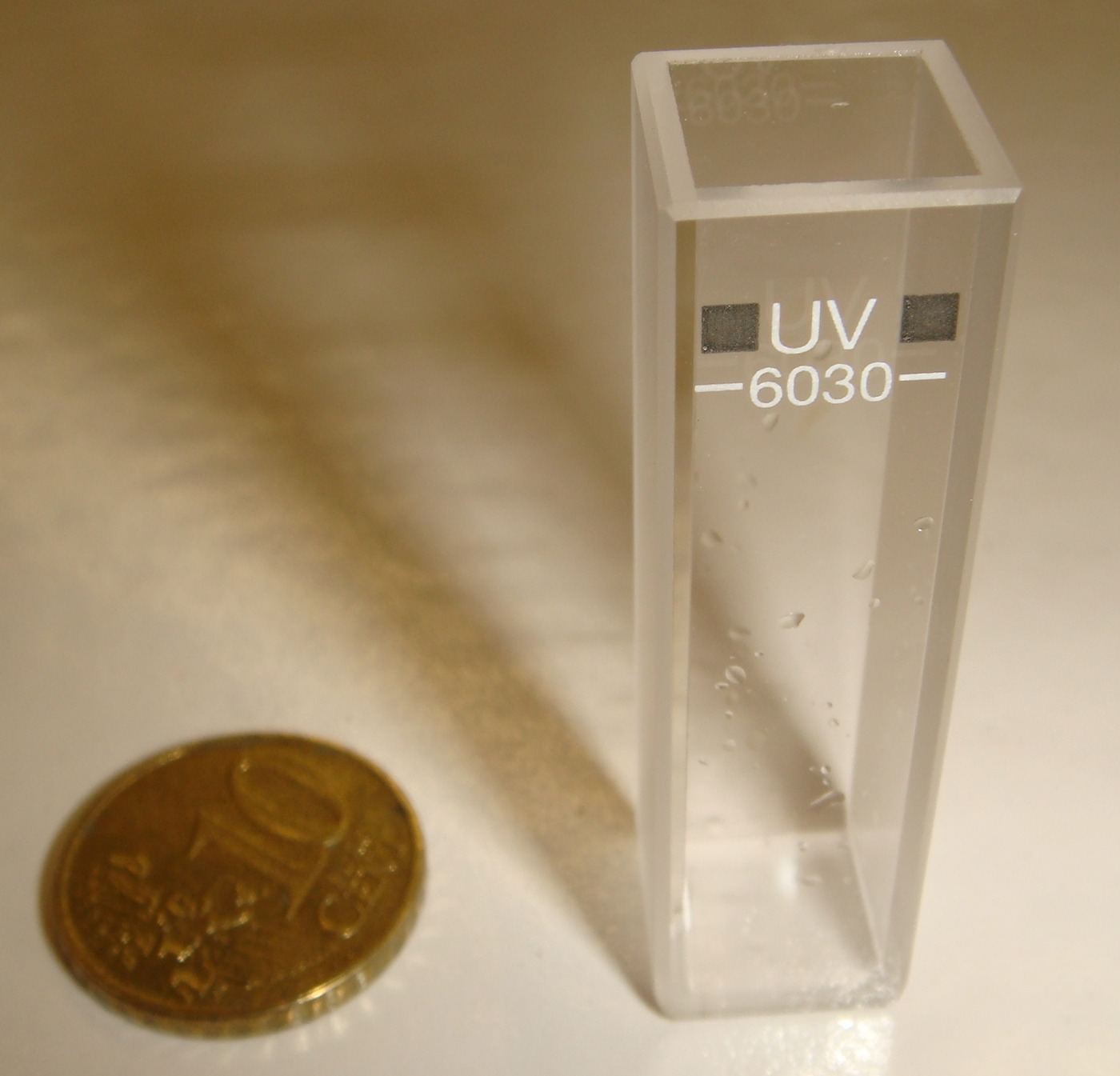
Micro and semi-micro cells exist for small volumes. Mettler Toledo gives 3.5 mL as the common capacity of a standard 10 mm macro cell and a rough way to estimate any cell's volume: inner length × inner width × inner height × 80%. Fill height matters too; one supplier recommends filling to about two-thirds to three-quarters of the height, so the beam passes through liquid and not the meniscus.
Two traps that are not about the cell
The solvent has a cutoff too. Many solvents that look transparent still absorb measurably below 240 nm, so blank against the same solvent batch as the sample. A perfect quartz cell does not rescue a method that runs its blank in a different bottle.
Fluorescence needs a different cell. A standard UV-Vis cell is polished on two opposing faces and the other two are ground or frosted. Fluorescence work, which collects light at 90 degrees, calls for four polished faces and low-fluorescence quartz. Ordering the absorbance cell for a fluorimeter is a quiet way to lose signal.
Tolerance and matching: what the pharmacopoeias actually say
This is the part buyers get wrong in both directions, buying certified cells for a classroom or standard cells for a regulated assay.
The European Pharmacopoeia's UV-Vis chapter (2.2.25) specified a cell path-length tolerance of ±0.005 cm. It also required that cells intended for the sample and for the compensation liquid give the same transmittance when filled with the same solvent. Starna's article in Spectroscopy Europe describes the revision that became mandatory in Edition 10.0 from 1 January 2020: the tolerance is stated as ±0.5%, which equals ±0.005 cm for a 1 cm cell but becomes a problem for short-path cells. The author points out that ±0.5% on a 1 mm cell would mean ±5 µm, while even reputable suppliers quote about ±10 µm. That is the author's argument against applying the percentage to short paths, and it comes from a cell manufacturer, so read it as an industry position.
USP <857>, for its part, sets absorbance accuracy for potassium dichromate solutions at ±1% (above 1.0 A) or ±0.010 A (below 1.0 A), whichever is larger. That is a test of the instrument, but it is run in cells, and your cells are part of what passes or fails. ASTM E925, the practice for monitoring UV-Vis calibration, says matched solution cells should be used for calibration.
Put those together and the specification follows from how the number will be used.
For teaching and screening, ordinary cells will do; one supplier describes its standard grade as ±0.05 mm, which is 0.5% on a 10 mm path. For numbers you report, ask the supplier for the path-length tolerance and the transmittance match in writing, because "matched" alone says little. Mettler Toledo quotes ±0.01 mm for its Excellence line, or 0.1%. For regulated calibration, buy cells that meet the pharmacopoeial tolerance and never split a pair.
One vendor figure needs correcting. A supplier's article states that two paired cells differing by 0.10 mm in worst case produce about 10% baseline drift at A = 1. The arithmetic gives 1%: 0.10 mm on 10 mm is 1% of the path, so a reading of 1.00 shifts by about 0.01 A. The same article's other figure, that a ±0.1 mm tolerance on a nominal 10 mm cell introduces about ±1% systematic error, agrees with that calculation. Treat the 10% as a slip in the source.
Pairs age, too. Two cells wear at different rates, so a pair that matched on delivery may not after months of use, and re-matching cells from loose stock fails when nobody kept the per-cell data. Re-check a pair occasionally: fill both with the same solvent and write down the baseline difference.
Handling: where routine error creeps in
No controlled study ranking the causes of cuvette error turned up in the research for this article, so a supplier claim that cuvette factors explain 60–80% of unexplained UV-Vis errors is worth discounting. The causes it lists are the ones every vendor lists, though.
Fingerprints come first. Mettler Toledo says to hold a cell only by its frosted sides, because grease or residue on a window adds absorbance, and to clean before and after use with 60% isopropanol in deionised water on an optical cloth or lint-free tissue. Keep cells in a holder between runs and in the original box for the long term. Scratches come second: a cell with scratches or small cracks in the polished field should be retired, Mettler Toledo says, both for the data and because it could break in the instrument.
Orientation is where sources split by grade of cell. Ocean Optics says absorbance changes with orientation when the path length is not identical in every direction, so use the same cuvette the same way round. Mettler Toledo says its tighter-tolerance cells make a preferred orientation unnecessary, with only marginal difference at 180°. For ordinary cells, marking one corner with a pencil on the frosted face is cheap insurance. Whichever grade you own, point the clear window at the beam, since a frosted face in the beam scatters badly.
Blank in the same cell. Two suppliers recommend using the same cuvette for blank and sample when you can. If you have two cells, check that blank-versus-blank reads near zero before you trust the pair.
Holder fit matters as much as the cell. Ocean Optics makes the point that even a matched set of quartz cuvettes gives poor data if they are placed inconsistently, and shows repeatability of 0.0007 AU standard deviation over ten insertions with its own holder. That is a seller demonstrating its product, but the principle is sound.
Equipvia may earn a commission from qualifying purchases through this link. The link resolved to Product ID 1600627362503 during review. CPS resolution does not verify the seller's technical claims, the quartz grade, affiliate eligibility, or commission attribution. Check the actual selected variant and current terms before ordering.
The listing does fix two of the five decisions. It names a 10 mm path and a 3.5 mL volume, which puts it in the standard macro cell class, and it includes a stopper. What it leaves open is the part that matters for a reported number: which quartz grade the cell is made from, its path-length tolerance, and whether a pair is matched. Ask for those three in writing, because a 10 mm cell in the wrong grade reads perfectly well at 254 nm and badly at 200 nm.
Choosing: a short decision list
- Find the lowest wavelength in your method.
- Pick the material with at least 20–30 nm of margin over its quoted cutoff: plastic or glass for visible-only work, quartz for 260/280 nm, deep-UV quartz below 220 nm.
- Estimate the absorbance you expect and pick the path length that lands it near 0.2–0.8.
- Decide whether you report the number or just look at it. If you report it, buy the cell with a stated path-length tolerance and keep a matched pair together.
- Check the solvent against the material before the first fill.
| Task | Cell | Why |
|---|---|---|
| OD600 growth curve | Disposable polystyrene | Visible only; single use |
| DNA at 260 nm | UV-grade quartz | Glass and plastic absorb |
| Peptide-bond region below 220 nm | Deep-UV quartz | Standard UV grade stops near 220 nm |
| Dissolution at 254 nm in a QC lab | Quartz with stated tolerance | Reported number; pharmacopoeial context |
| Very concentrated dye | Short path (1–2 mm) | Avoids dilution |
Share this article