Autosampler Vials and Caps: Thread Finish, Septa and Glass or PP
Over 56 hours, no cap tested held a volatile analyte. The best lost 26%, the worst 68% — and the difference was the injector, not the cap.
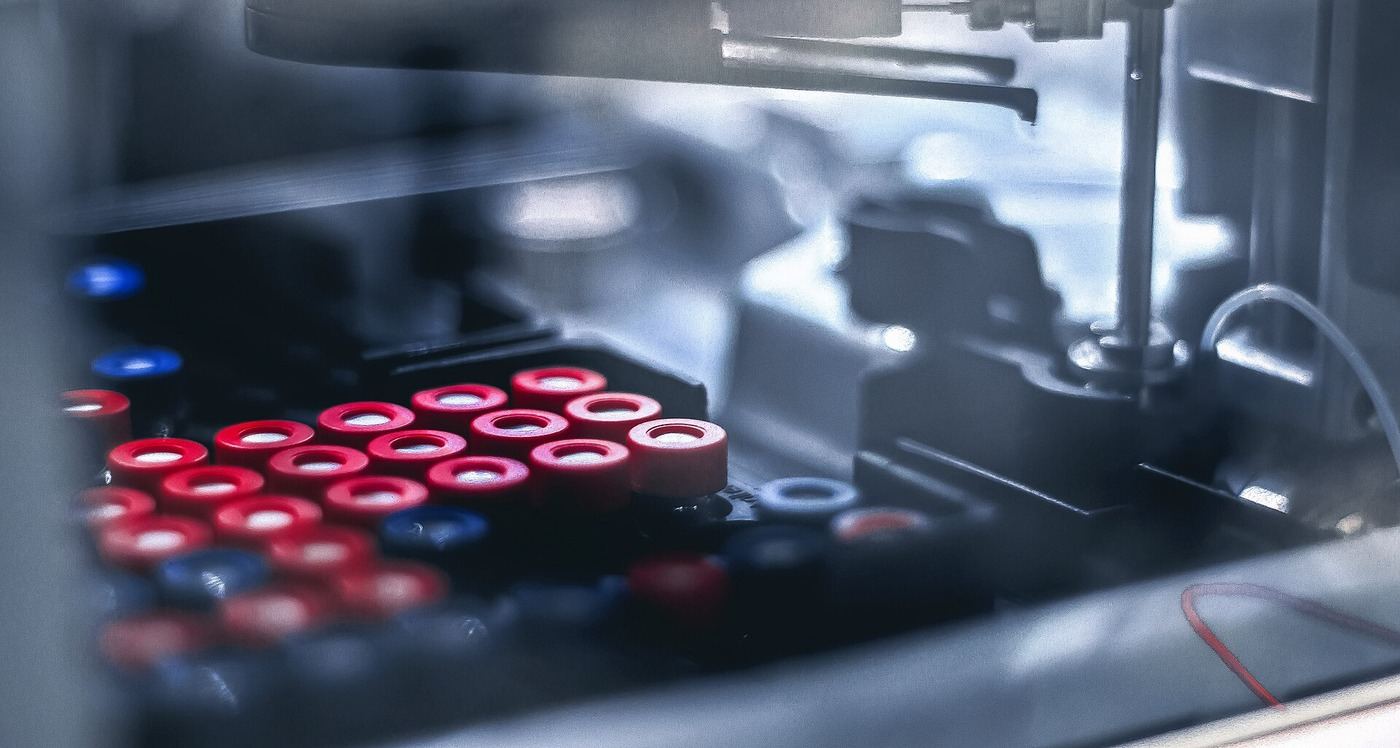
Disclosure: We may earn a commission if you purchase through links on this page, at no additional cost to you. Our selection criteria do not depend on commission; see our affiliate disclosure.
Vials are the most thrown-away item in a chromatography lab, so nobody studies them. They should. A vial is the last container your sample sits in before it reaches the instrument, and the glass, the cap and the septum can each change what the detector sees: a basic compound sticks to the wall, a volatile solvent leaves through the puncture, a siloxane comes off the septum and shows up as a peak.
This guide works through four choices in the order you actually face them: whether the vial fits your autosampler, which septum goes in the cap, whether glass or polypropylene suits your analyte, and when a vial has done its one job. Most of the hard numbers come from manufacturers' application notes, so the source is marked, and so are the places where they disagree.
Fit first: thread finish and autosampler
Screw-thread vials are named by a two-part code. One catalogue explains that in "8-425" the first number is the outside diameter of the thread area in millimetres and the second is the thread style, with the finishes defined by the Glass Packaging Institute. Common codes in the autosampler range are 8-425, 9-425 and 10-425, with 13-425 for larger 4 mL vials. Crimp and snap-cap vials are usually the 11 mm size, and headspace vials the 20 mm size.
The catch is that matching the code to the cap is not enough. Agilent's vial guide includes a compatibility chart that lists, for each autosampler model, which vial formats work, and it measures the septum seat diameter for each. Fisher Scientific makes a related point: septa that are too thick may prevent the cap from fitting. So the order of checks is:
- Look up your autosampler model in the manufacturer's vial compatibility table.
- Pick the neck style that table allows. Fisher describes its 9 mm short-thread vial as universally compatible with almost all autosamplers, which is a vendor claim worth checking against your model.
- Buy the cap and septum the vial maker specifies for that thread. Mixed-brand caps and vials sometimes work and sometimes leave the septum slightly loose or over-compressed.
On crimp versus screw, one catalogue notes screw caps are easier to handle and need no special tools, but cost more than crimp seals. Over-tightening is a real failure mode: MicroSolv warns that it can deform septa, and recommends consistent hand-tightening or a torque fixture. Thermo sells caps with a built-in tightening stop, which tells you the problem is common enough to design around.
Septa: what the layers are for
A typical autosampler septum is a layer of silicone rubber with a PTFE face. The rubber reseals after the needle. The PTFE keeps the sample solvent off the rubber, where it could leach plasticisers or siloxanes into your sample. That is why the PTFE layer must face the sample.
Thermo's septa selection chart gives a quick sorting rule for the common types:
- Natural rubber with PTFE: not recommended for multiple injections or for holding samples for further analysis, because once the PTFE is broken the rubber is exposed to chemical attack.
- Silicone laminated to PTFE: described as preferred for liquid chromatography, with strong resealing and resistance to coring.
- PTFE on both sides of silicone: described as most resistant to coring, with above-average resealing.
- Pre-slit silicone/PTFE: for very thin needles, or where a vacuum may form in the vial.
- Thin 1.4 mm PTFE-faced seals: resealing is limited by the thin silicone layer.
- High-temperature low-bleed septa: for GC use up to 300 °C.
Pre-slit septa matter for two reasons. They are easier for fine needles to pass through, and they prevent the vacuum that can form when a vial is sampled repeatedly with no air path. MicroSolv adds that you should choose the slit geometry to suit your autosampler.
How much does resealing matter?
More than most people assume, and less than vendors suggest for volatile analytes. Waters ran the clearest public test found for this article. The authors put 200 µL of a reversed-phase reference mixture (65:35 methanol to 20 mM phosphate buffer, pH 7) in vials sealed with six of its own cap types, then injected 1.0 µL from each vial eight times over 56 hours, with injections every 8 hours, on two different instruments. They tracked a volatile compound (naphthalene) and a non-volatile one (amitriptyline).
The results split by injector. On the fixed-loop system, naphthalene's peak area fell by 48% to 68% depending on cap. Amitriptyline rose by 4% to 22%, because the volatile solvent was leaving and concentrating the rest; three cap types held that rise under 7%. On the flow-through-needle system, naphthalene still lost 26% to 36%, but amitriptyline stayed within −1% to +3% for every cap. The authors attribute the difference to needle size: about 1.00 mm outside diameter for the flow-through needle against 1.83 mm for the fixed loop, so the smaller puncture reseals better.
Three practical points follow, all from the note. No cap prevented a significant loss of the volatile analyte over 56 hours. A frequently changed cap is the safe approach when volatile concentration matters. And for critical work, run your own concentration-versus-time test on your own system, which costs one sequence. The data come from the maker of those caps and cover only its own six septa, so they say nothing about other brands.
Septum bleed from the vial
The vial septum can behave like the GC inlet septum, only at room temperature. In Chris English's The Column article for Restek, methylene chloride leached siloxanes from vial-cap septa, especially after more than one puncture: in one test, five consecutive injections from a single vial gave septum bleed peaks nearly as large as the analyte peaks. English also reports that without a PTFE protective layer, bleed from a vial septum was detectable after 24 hours at ambient temperature. His recommendations: use PTFE-lined septa and limit repeated punctures of one cap. The signature m/z 73 ion pattern looks the same as inlet septum bleed, which is why the two get confused; injecting clean solvent through a fresh vial and cap separates them.
Glass or polypropylene
Fisher lists both materials, and most catalogues call the glass "Type I borosilicate." That label alone tells you little about how a basic drug will behave in it.
What glass does to basic compounds. Shimadzu's technical tip describes the mechanism: a basic compound is adsorbed to silanol groups on the inner glass surface by ion exchange, quickly after dispensing and then more gradually. In its chlorhexidine test (1 mg/L in water, recovery after 24 and 72 hours relative to polypropylene vials set at 100%), vials differed in both recovery and how recovery changed with time. The numbers appear only in a figure, so they cannot be quoted here. A Shimadzu poster on a low-adsorption glass vial, which is a product comparison, reports amitriptyline at 1 mg/L recovering at 88% in one vendor's LC-MS vial and 42% in another vendor's standard vial. It is Shimadzu data about Shimadzu's product, so weigh it as such.
An independent, published example is more useful. Stadler, Seaman, Bhatt and Zhao of St. John Fisher University reported in LCGC International (November 2025) a test of benzalkonium chloride at 25 ppm in a pH 6.8 isotonic buffer across six HPLC vial types from three vendors. After 60 minutes, the low-cost glass vial lost 4% of the C12 homologue, 19% of C14 and 32% of C16. The other four glass types lost 5–10% of C14 and 22–32% of C16, and that group included premium and silanised glass. Polypropylene lost none of C12 and C14 and 6% of C16. The authors conclude that no glass vial fully prevented the loss, that ionic attraction to silanols does not fully explain it (hydrophobic interaction is probably also involved), and that adsorption is hard to predict from vial properties, so vial compatibility should be tested early in method development.
Polypropylene has no silanols, so the ion-exchange loss disappears, but hydrophobic analytes move the problem somewhere else. Shimadzu's poster puts it in one line: basic compounds stick to glass, hydrophobic ones to polypropylene. Its amiodarone test, a drug that is both basic and hydrophobic, showed loss in both vial types. MicroSolv cautions that polypropylene vials differ in additives that can leach and appear as extractable peaks, and the vial maker is the one to ask about organic solvents.
Sodium is the other thing glass hands over. Shimadzu says metal silanolates on borosilicate surfaces dissociate in neutral solvent and release sodium, enough to shift pH and solubility. In its meloxicam LC-MS test (5 mg/L, 48 hours) some glass vials gave sodium adducts above half of the total signal, which hurts if you quantify on the protonated ion. Shimadzu's fix is low-alkali glass, which happens to be its own product, so take the mechanism as the finding and the brand as the pitch.
A working rule, which no source states: standard glass is fine for neutral, non-volatile analytes at ordinary concentrations. For basic drugs, peptides or quaternary ammonium compounds at low levels, run your normal vial against a polypropylene or deactivated-glass vial before you validate.
Small samples: inserts and residual volume
A 2 mL vial never delivers 2 mL. Fisher puts residual volume at under 170 µL for its standard flat-bottom 9 mm and 1.5 mL vials. With 50 µL of precious extract, that dead volume swallows the whole sample, and inserts are the answer. VWR's have a polymer spring that keeps the insert centred and cushions the needle. Thermo sells vials with the insert fixed inside, aimed at samples that must be evaporated and reconstituted without a transfer. One inference worth making: if you picked polypropylene to dodge silanols, pick a polypropylene insert, since a glass insert puts the silanols back.
Re-washed vials: the false economy
Reusing vials is tempting when they are expensive. Thermo's technical note TN 20670 tested it, and the results are not subtle.
Vials put through several dishwasher cycles lost more methanol to evaporation than new ones. So did septa lifted from used caps, which the authors blame on split PTFE and silicone layers. The washing also ground down the threads, clouded the glass, and stripped off the writing patches. Then came the chromatography. In GC-MS, methanol blanks in re-washed vials carried cyclic polysiloxanes and other contaminants absent from new vials, and the contamination changed from vial to vial with what each had held before. After three runs, GC performance declined even on clean blanks, and the liner showed deposits, among them black fragments of discoloured silicone. HPLC-UV picked up extra peaks at 220 and 254 nm. In LC-MS, a reused septum on a re-washed vial raised the background fivefold.
Thermo's advice is new vials and septa every time, on the grounds that retesting costs more than the vials. It sells vials, which colours the advice, but each observation is something you can reproduce in your own lab with a handful of vials and a methanol blank.
One test worth running before you buy a thousand
Waters' design scales down well. Fill eight vials with your real sample at your real volume, cap them with the candidate cap, load them in your autosampler tray, and inject from each at fixed intervals across your longest planned sequence, say every 8 hours for 56 hours as Waters did. Plot peak area against time for your most volatile analyte and for a non-volatile one. If the volatile falls steeply, the cap is not the whole answer, because Waters found no cap held it. If the non-volatile climbs past what your method allows, you are concentrating the sample through the puncture. Repeat with a second cap type and you have your own resealing comparison. This is an adaptation of a published design, not a published protocol.
Equipvia may earn a commission from qualifying purchases through this link. The link resolved to Product ID 1601564146376 during review. CPS resolution does not verify the seller's technical claims, the vial's fit, affiliate eligibility, or commission attribution. Check the actual selected variant and current terms before ordering.
The listing states borosilicate glass and sells the vials as a kit with septa, from $2.80 a set. It does not state the thread finish, and that is the one field that has to match your autosampler's compatibility table before anything else matters. Ask for the thread code, whether the glass is a low-adsorption grade, and how the septum is built: which side carries the PTFE, and whether pre-slit caps are available.
What the symptoms usually mean
Late-eluting, evenly spaced peaks with m/z 73 point at septum siloxanes, and they get worse with methylene chloride and repeated punctures (English, Restek). A volatile analyte whose area sinks across a long sequence says the septum is not resealing, while a non-volatile one that creeps upward says the diluent is leaving through the puncture (Waters). A basic compound with low, drifting recovery has probably found the glass (Shimadzu; Stadler and colleagues). Extra UV peaks at 220 and 254 nm after you switched to washed vials are the reuse penalty (Thermo), and poor protonated-ion response in LC-MS can be sodium adducts from the glass (Shimadzu).
If you carry one rule out of this guide, make it the first one. Look up your autosampler in the maker's vial table before you compare any thread codes, and let that table narrow the field.
Share this article