GC Inlet Liners: Wool or None, Taper or Straight, and Matching One to the Injection
In one liner evaluation, endrin breakdown was 1.2 % on injection one and 12.2 % on injection 101. Nothing failed, and the number climbed anyway.
Disclosure: We may earn a commission if you purchase through links on this page, at no additional cost to you. Our selection criteria do not depend on commission; see our affiliate disclosure.
A GC inlet liner rarely fails on a particular day. It drifts. In one Agilent evaluation of its Ultra Inert liners, endrin breakdown in a splitless test was 1.2 % on the first injection and 12.2 % on injection 101, with DDT moving from 2.5 % to 3.0 % over the same run. Nothing broke, no alarm sounded, and the number climbed anyway. That is the real selection problem: you are not buying a piece of glass, you are buying a surface that will slowly change while you rely on it.
Here is what follows: wool or none, taper or straight, how the liner's volume squares with the solvent you inject, and how you know a liner is finished. EPA methods supply the only hard numbers. Past those the evidence is journal abstracts and vendor notes. The vendors sell the liners they compare, so each claim carries a name, and where they contradict each other both are shown. The two EPA methods were read in the agency's own PDFs, the vendor material as published, and the journal papers only as abstracts.
What the regulators actually measure
The cleanest definition of "inert enough" sits in environmental methods. Method 8270E, EPA's GC/MS procedure for semivolatiles, builds the check into the tune solution, which carries DDT, pentachlorophenol and benzidine. Breakdown of DDT to DDE and DDD is capped at 20 %, and benzidine and pentachlorophenol must not tail past a factor of 2. The checks become optional if your targets are PAHs or PCBs rather than reactive compounds. A bad result sends you to the injection port, and the method says the first 6 to 12 inches of column may also need cutting.
Method 8081B, for organochlorine pesticides, is stricter and more specific. It sets the corrective-action trigger at 15 % breakdown for either DDT or endrin, to be checked before calibration and at the start of each 12-hour shift. It attributes breakdown to a liner contaminated with high-boiling residue or to metal fittings in the injector, and its remedy is to clean and deactivate the port and remove at least 30 cm of column. It also says to run the check even when DDT and endrin are not on the target list, as a general test of the system. EPA's SW-846 FAQ repeats that the check is still required for 8081B in that case.
So even the regulators do not agree on a number: 20 % in 8270E, 15 % in 8081B. Agilent's drinking-water note describes Method 525.2 as allowing no more than 20 % for endrin or DDT, and a Restek article gives the same figure for Method 508.1. Neither method says which liner to use. Both EPA PDFs were searched for guidance on glass wool, and there is none in 8081B, and none in the readable excerpt of 8270E. The regulators set the pass line and leave the glass to you.
Wool or no wool: the part where the sources split
Wool does three jobs, according to Phenomenex, Restek and Trajan literature. It gives the injected liquid a surface to vaporise from, it wipes the syringe needle tip, and it catches non-volatile residue before it reaches the column. Phenomenex shows a rose oil extract giving a much larger response through a single taper liner with wool than one without, and Agilent's own training slides report split-injection volume reproducibility of 0.9 to 2.4 % RSD with wool against 3.3 to 9.9 % without it, for C10 and C44 at split ratios from 50 to 200.
The problem is that wool is also the largest piece of active surface in the inlet. Three positions in the literature:
- Restek's liner series recommends a single taper liner with wool, or a Cyclo liner, for splitless injection of liquids. It says quartz wool is preferable to borosilicate because it carries fewer impurities, and that with a good deactivation, wool is seldom a problem in split mode.
- Agilent's catalogue text for its splitless liners, as reproduced on a distributor's page, takes the opposite default: try a liner without wool first, and use wool as a second choice. For unknown samples it advises no wool, to avoid loss of active or labile compounds. Yet Agilent also sells Ultra Inert wool liners and publishes application notes showing them working well for pesticides, and it describes older wool deactivation as historically poor.
- Trajan's technical paper sits between the two. It says wool helps vaporisation when properly positioned, but that even fully deactivated quartz wool can cause breakdown of very active analytes, and that injecting onto the wool rather than into it can matter.
A column by Jack Cochran in LCGC adds a specific case: phenols were lost to even fresh, well-deactivated quartz wool during splitless injection, with the slow inlet flow making it worse. In a different LCGC study of hydrocarbons, a single taper liner with wool and a Cyclo liner gave the best overall response from C8 to C40, while empty straight and single taper liners lost response for higher boilers. And an older Restek application note found that a drilled Uniliner reduced endrin and DDT breakdown relative to splitless liners, with or without wool.
The summary is that these are all defensible findings about different analytes, not a contradiction about one. High-boiling hydrocarbons and dirty extracts benefit from wool. Phenols, chlorinated pesticides, and thermally labile compounds are where wool, however well deactivated, adds risk. A sintered frit is a vendor's alternative: Agilent reported 0.9 % DDT breakdown on average for a frit liner against Method 8270D/E criteria, and a pesticide study where the frit retained greater response than wool liners through 70 matrix injections. That is one manufacturer's data on its own product.
The one peer-reviewed liner comparison found says geometry may matter more than coating. Cheng and Kerrigan (2023), working on cannabidiol cyclising to Δ9-THC in the inlet, tested seven commercial liners and saw differences in decarboxylation and in THC formation between types, particularly those of different geometry. For Δ9-THC formation, they report that deactivation mattered to a smaller extent than geometry, that effects were exacerbated with liner use, and that lot-to-lot differences within a type were not observed. This is an abstract-level reading, on cannabinoids. It does not tell you which liner to use for pesticides. It does support spending time on the shape and not only on the word "deactivated" in the catalogue.
The rule that follows is judgment, not published: start with no wool for anything labile or unknown, add deactivated quartz wool when reproducibility or non-volatile matrix demands it, and treat the result as a method decision to be verified with a breakdown check, not as a purchase preference.
Shape and volume: matching the liner to the injection
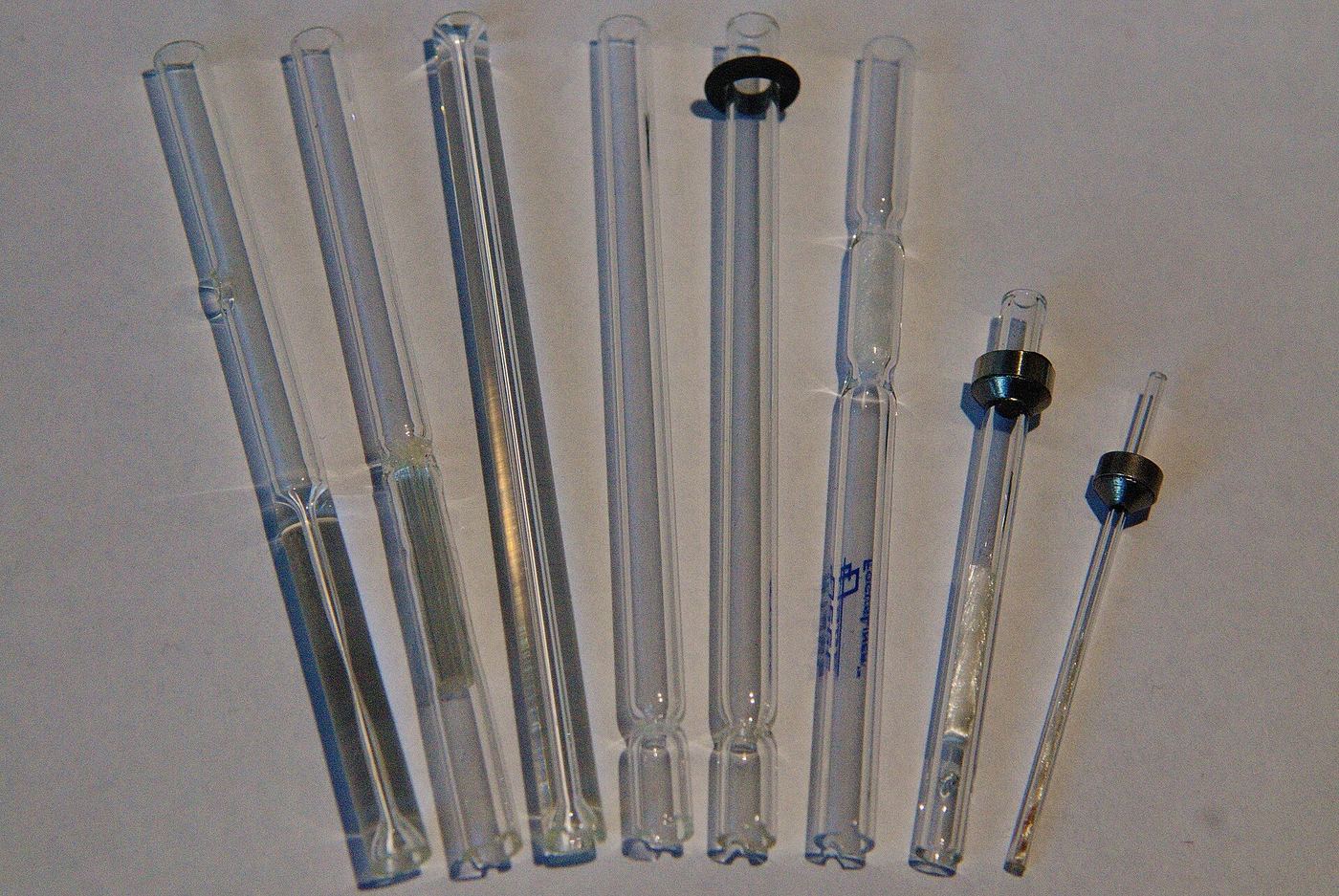
Split injection and splitless injection want different liners, and mixing them up is a common source of poor peak shape. Restek's series and an American Laboratory note agree on the basic pattern. Splitless work uses a single taper (or Cyclo) design that funnels the vapour to the column and keeps it off the hot metal seal below. Split work uses straight or specialised designs that mix well, and a straight liner with a narrow bore suits gas samples or fast GC with narrow columns, according to American Laboratory and Trajan. Splitless injections run at low inlet flow, so analytes sit in the liner for longer. Restek makes the point that this longer residence time is why splitless suffers more from adverse interactions.
Volume is the quieter constraint. The injected liquid expands to a vapour cloud that must fit inside the liner, or it will backflush into the gas lines and give ghost peaks and poor repeatability. Agilent's training slides tell users to match injection size to the liner's internal volume and point to a volume calculator. Liners in Trajan's comparison range from about 600 to 810 µL. For a sense of scale, the expansion here was worked out with the ideal gas law, assuming 250 °C and an inlet pressure of about 15 psig (roughly 2 atm absolute) and room-temperature liquid densities. That gives roughly 330 µL of vapour from 1 µL of dichloromethane, about 160 µL from 1 µL of hexane, and about 530 µL from 1 µL of methanol. These are approximations, and a vendor calculator will differ, but they show why a 2 µL methanol injection into a 4 mm single-taper liner is a gamble.
Fit is a purchase issue of its own. Restek's product listings give the common Agilent split/splitless size as 4.0 mm ID by 6.3 mm OD by 78.5 mm long, and Agilent's catalogue text, again via a distributor, says the outer diameter of its splitless liners is ground to tight tolerances. Instruments from other makers use other dimensions and seals, so take the dimensions from your instrument manual, not from a product title.
Equipvia may earn a commission from qualifying purchases through this link. The link resolved to Product ID 1601835524457 during review. CPS resolution does not verify the seller's technical claims, the dimensions, affiliate eligibility, or commission attribution. Check the actual selected variant and current terms before ordering.
A part number in the title is the whole risk here. Liner part numbers are instrument-specific, the same number can be quoted by sellers for different items, and a liner that is a millimetre wrong in outer diameter will not seal. Before ordering, take the ID, OD and length out of your own instrument manual and compare them with what the seller confirms in writing, then ask whether the liner is empty or contains wool, because a single "split/splitless liner" title covers both and they behave differently on the first injection of a labile compound.
Deactivation, and how long a liner lasts
Deactivation covers silanol groups on the glass. There are no standard wool deactivations, and the vendors say so: Agilent and Restek each describe their process as proprietary and argue theirs is better, which is not something an outsider can adjudicate. What is checkable is the breakdown test itself. Restek describes DDT and endrin as probes because they are sensitive to active sites in a hot inlet, and says that if either exceeds 20 % under Method 508.1 then inlet and column maintenance is required.
Lifetimes are matrix dependent, so published numbers are best taken as examples. Agilent's Ultra Inert test, with one 50/100 ppb endrin/DDT standard followed by nine solvent blanks, repeated for 100 cycles, produced the 1.2 % to 12.2 % endrin drift quoted earlier. Its Method 525.2 note on an 8890 GC reported average degradation of 5.95 % for endrin and 0.54 % for DDT across the run. Its Method 8270 frit liner note reports tailing factors for pentachlorophenol and benzidine below 1.6, and continuing-calibration performance after more than 200 injections. These come from three different setups and conditions, so they cannot be compared with each other. What they do show is that a good liner is measured in hundreds of clean-solvent injections, and a dirty extract shortens that. Cochran's LCGC article states that extracts rich in involatile material deposit residue on wool and the bottom seal and catalyse degradation.
For hard-to-protect compounds, there is a different lever. Analyte protectants, compounds that mask active sites, are used in pesticide work, and a 2025 Forensic Chemistry paper by Mulloor, Wilson and Sander proposed that THCA and Δ9-THC interact with silanols on heated inlet surfaces and showed that protectants reduced the effect. That was cannabis analysis, but the mechanism is the same one that deactivation tries to address.
A short reorder and replacement routine
This is a condensation of the above and not a published procedure.
- Write down the injection mode, solvent, injection volume and the most reactive analyte on your list. They decide almost everything else.
- Pick the geometry for the mode, then check that the solvent's vapour volume fits. Use a vendor calculator if you have one.
- For labile analytes, begin with an unwooled deactivated liner. Add wool only if the data show you need it.
- Run a DDT/endrin or similar breakdown check on each new liner, so that you have a baseline number.
- Replace on a trend in that number or in tailing, not on a calendar. If you cannot run the check, shorten the interval for dirty matrices.
What else to check
A new liner on a dirty inlet gains little. Both EPA methods point to the whole path. 8081B names metal fittings and contaminated residue, and 8270E suggests trimming the column and mentions a guard column as a way to protect the analytical column. Seals and O-rings sit at the same location as the liner, and a worn seal can undo a good liner.
What this article could not check
Full texts were not available for the Cheng and Kerrigan or Mulloor papers, only abstracts. Vendor comparisons come from sellers, mostly Agilent, Restek, Phenomenex and Trajan, each with an interest in its own products, and they tested different analytes. The EPA 8270E document was read as an excerpt, so there may be liner guidance not seen. The vapour volumes are estimates worked out here, not measured.
Share this article