Lab Refrigerators for Flammables: Flammable-Safe against Explosion-Proof against Domestic, and the 12 °C Flash Point
Nine arcing points inside a domestic refrigerator, ethanol flashing at 12 °C, and a 4 °C setpoint that actually swings between 2 and 14 °C — which is above the flash point of most of the solvents in it.
Disclosure: We may earn a commission if you purchase through links on this page, at no additional cost to you. Our selection criteria do not depend on commission; see our affiliate disclosure.
Published figures: any material with a flash point below 100 °F (38 °C) goes only in a UL-listed flammable-material-storage refrigerator or freezer; pure ethanol flashes at 12 °C; and a standard refrigerator set to about 4 °C actually runs between roughly 2 and 14 °C. A flammable-storage refrigerator is sold with a 1 to 12 °C range — which means the top of its own range equals ethanol's flash point. Below, the numbers are set side by side and the disagreements listed rather than settled.
Three kinds of cold storage
Three types are named in the sources: household, lab-safe (also called flammable-safe or de-sparked), and explosion-proof. One university gives a four-row table that adds a modified domestic unit, and another names only two types, merging the lab-safe and explosion-proof categories.
What each is:
- Domestic: often has an interior light and auto-defrost, and no flammables go inside.
- Modified domestic: acceptable only on older manual-defrost models with no lights, and relocating ignition sources voids the warranty.
- Flammable-safe: the preferred type — self-closing doors, magnetic gaskets, special liner materials, all electrical components outside the storage compartment, and the compressor sealed or mounted on top.
- Explosion-proof: protects against ignition of vapour both inside and outside the compartment, installed under Article 501 of the electrical code, with enclosed motors, an FM or UL explosion-proof label and direct wiring through metal conduit.
Why a domestic refrigerator fails
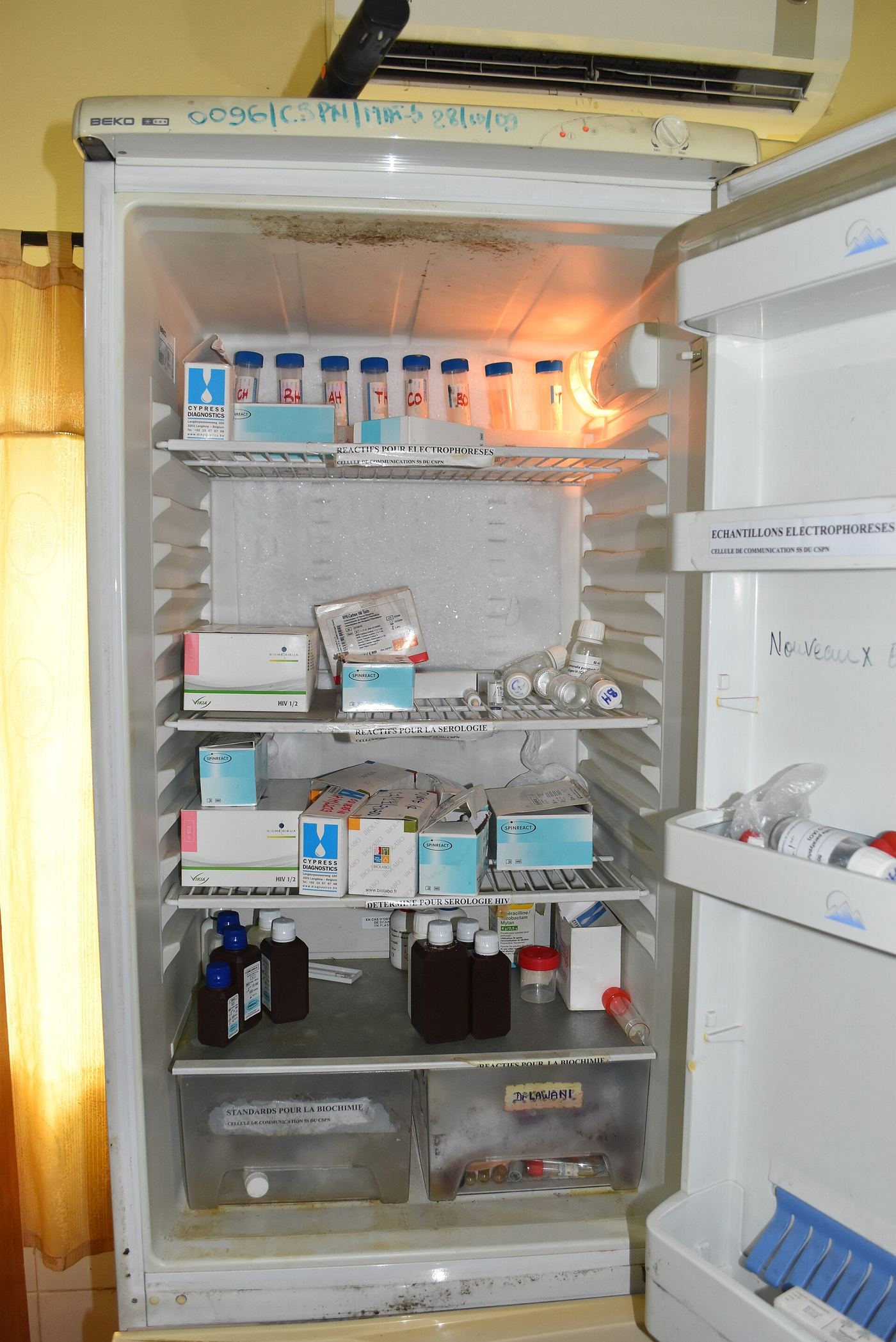
Seven ignition sources are named inside an ordinary refrigerator: thermostat, interior light, door light switch, defrost heater, defrost control switch, compressor and fan. One university counts up to nine arcing points in the storage compartment of a domestic or general-purpose unit, against fully vapour-sealed or semi-sealed compressors in commercial laboratory units. Another notes that frost-free models often have a drain tube that carries spills toward the compressor.
Incidents in the source pages: unsealed tubes of petroleum ether in a domestic freezer in 1982, where vapour passed the lower explosive limit of about 1.0 percent and no one was hurt because it happened at night; a refrigerator that blew its door 20 feet and broke a window in 2014, cause not reported; and a university refrigerator that exploded from a small amount of flammable material, tore off the door, injured several firefighters and cost several hundred thousand dollars.
The vapour arithmetic is the part that surprises people. Filling the nominal interior evenly to the 1.0 percent lower limit needs 1.6 L of vapour in a 5.5 cu ft (155.7 L) unit, 2.3 L in 8 cu ft (226.5 L), 7.1 L in 25 cu ft (707.9 L) and 8.5 L in 30 cu ft (850 L). A few millilitres of liquid is enough to get there.
Equipvia may earn a commission from qualifying purchases through this link. The link resolved to Product ID 11000027146849 during review. CPS resolution does not verify the seller's technical claims, the temperature range, affiliate eligibility, or commission attribution. Check the actual selected variant and current terms before ordering.
The name "spark-free" is the claim to test, not a certification. What makes a unit acceptable is that every ignition source is outside the compartment: no interior light, no defrost heater, the thermostat outside, the compressor sealed. Ask for the temperature range, because a 1 to 12 °C unit set to 12 °C is at ethanol's flash point; ask which listing the unit holds, because "spark-free" appears on units that are merely de-sparked rather than listed to the standard; and ask whether the door self-closes, since a door left ajar defeats the whole point.
The 100 °F flash point rule
Three universities use the same line: below 100 °F (38 °C) closed-cup flash point, use a flammable-material-storage unit. One lists flash points for common solvents in degrees Fahrenheit, converted here to Celsius:
| Solvent | °F | °C |
|---|---|---|
| Ethyl ether | −49 | −45.0 |
| Hexane | −7 | −21.7 |
| Acetone | 4 | −15.6 |
| Tetrahydrofuran | 6 | −14.4 |
| Cyclohexene | 10 | −12.2 |
| Benzene | 12.2 | −11.0 |
| Petroleum ether | 20 | −6.7 |
| Triethylamine | 20 | −6.7 |
| Ethyl acetate | 24 | −4.4 |
| Toluene | 40 | 4.4 |
| Acetonitrile | 42 | 5.6 |
| TEMED | 50 | 10.0 |
| Isopropanol | 53 | 11.7 |
| Methanol | 54 | 12.2 |
| Dioxane | 54 | 12.2 |
| Ethyl alcohol | 55 | 12.8 |
| Pyridine | 68 | 20.0 |
| Propyl alcohol | 74 | 23.3 |
| Butanol | 84 | 28.9 |
| Xylene | 84 | 28.9 |
Counted against setpoints: 9 of the 20 flash below a 4 °C setpoint, and 16 of 20 flash at or below 14 °C, the top of the observed operating range. Only butanol, propyl alcohol, pyridine and xylene sit above 14 °C — and all 20 are below 100 °F, so every one of them needs a flammable-safe unit rather than a domestic one.
Petroleum ether appears at 20 °F on that list and at −56 °F in one university's account of the 1982 explosion: a gap of 76 °F or 42 K for a product the sources do not identify by boiling cut.
Ethanol, the common case
Pure ethanol flashes at 12 °C and 40 percent vodka at 26 °C, while a refrigerator set to 4 °C runs over roughly 2 to 14 °C. Another university lists ethyl alcohol at 55 °F, which is 53.6 °F in Celsius terms — within 1.4 °F of the 12 °C figure.
The consequence is simple: the 14 °C top of the operating range is 2 °C above ethanol's flash point, the 4 °C setpoint is 8 °C below it, and a flammable-material unit set to its own 12 °C maximum equals ethanol's flash point exactly.
Setpoints, freezers and the −40 °F line
Vendor ranges: a 5.5 cu ft refrigerator at 1 to 12 °C; an 8 cu ft combination unit at 2 to 10 °C with a freezer side at −18 to −5 °C in one listing and −12 to −20 °C in another; a standard series at 1 to 10 °C; and an explosion-proof freezer at −15 to −25 °C.
Two universities state that ultra-low freezers colder than −40 °F generally cannot be approved for flammable storage. Typical set points are 4 °C for refrigerators and −20 or −80 °C for freezers.
Conversions: −40 °F is −40 °C, −80 °C is −112 °F, −20 °C is −4 °F and 4 °C is 39.2 °F. So a −80 °C freezer is 40 °C colder than the −40 line, and the −12 to −20 °C freezer range is 10.4 to −4 °F.
Where the sources disagree
- Is explosion-proof needed? One university says allowed but not necessary, since flammable atmospheres should not occur; another says very limited use, required where an atmosphere may form, as in solvent dispensing rooms; two more call it rare or not commonly required, one of which then says to use an explosion-proof unit if refrigeration is needed inside a flammable-storage room. A fifth page states that flammable chemicals "must be stored" in units designed to be explosion-proof, merging the two categories.
- Terminology: one university says a flammable-material-storage refrigerator is "also known as explosion proof"; a manufacturer says flammable-storage units cannot be used in explosion-proof applications; and a supplier manual says its flammable unit "is not an Explosion Proof" one.
- Modified domestic units: allowed only with no lights and manual defrost in one source; flammables go only in units designed to be explosion-proof or free of internal sources in two others.
- Electrical class: two universities say Class I, Division 1; one manual describes the cooling chamber of an explosion-proof unit as Class I Division 1 or Zone 1; and two product pages say Class I, Division II, Groups C and D, with a third adding Groups A and B. A state guide citing 1986 editions describes Division 1 as continuously exposed to vapour in normal operation.
- The refrigeration section cited in the laboratory fire standard is 12.2.2 in one source, 11.3.2 in another, and annex A.11.3.2.2 in a third.
Sizes and power on the market
A 5.5 cu ft flammable-material refrigerator is 155.7 L at 115 V and 160 W; a two-door unit is 10 cu ft or 283 L at 1.9 A and 115 V; a 25 cu ft unit is 707.9 L with a 49-inch interior height; a standard series offers 14, 17 and 20 cu ft, where 20 cu ft is 566 L; and a 30 cu ft unit is 850 L at 6 A and ⅓ HP. An explosion-proof 20.9 cu ft unit is 34 inches wide and hard-wired through rigid metal conduit.
Checks: 5.5 cu ft is 155.7 L, 8 cu ft is 226.5 L and 30 cu ft is 849.5 L; 115 V at 1.9 A is 218.5 VA and at 6 A is 690 VA, so the 30 cu ft unit draws 3.2 times the current of the 10 cu ft one; and 20.9 cu ft is 592 L.
A worked check for one bench
A hypothetical stock: 2 L ethanol at a 12.8 °C flash point, 1 L acetone at −15.6 °C, 1 L tetrahydrofuran at −14.4 °C and 2 L hexane at −21.7 °C.
The result: 6 L total, which is 3.9 percent of the nominal interior of a 155.7 L cabinet; all four are below 100 °F, so all four need a flammable-material unit; three of the four flash below a 4 °C setpoint; and ethanol sits 8.8 °C above the setpoint but 1.2 °C below the 14 °C upper observed temperature. If the lab also dispenses these solvents in the same room, three sources point toward explosion-proof for that room while one does not.
What the listings claim
Vendor claims, not standards: a 5.5 cu ft unit "UL listed meets NFPA 45 and 70", with R134a on one listing and R600a on another, and a 13-month warranty; a two-door unit complying with OSHA 29 CFR 1910.106 and NFPA 45, 56C and 99, with an orange "Flammable Material Storage Refrigerator" label and the thermostat on the outside rear; a series with two-year parts and labour and five-year compressor parts; a hydrocarbon-refrigerant series that is ETL listed; and hazardous-location units that are UL listed, hard-wired and supplied without a line cord.
Footprint and weight from a listing: 29 × 23.63 × 33.5 in is 73.6 × 60.0 × 85.1 cm, with clearances of 4 in at the sides, 3 in at the back and 4 in on top — 10.2, 7.6 and 10.2 cm — and weights of 54.5 kg, 45.3 kg or 36.2 kg depending on the listing; the 10 cu ft two-door unit is 77.1 kg. The footprint works out at 685 sq in, or 0.44 sq m.
Cost marks from one university: domestic and modified domestic one dollar sign, flammable-safe two, explosion-proof four — twice the flammable-safe mark and four times the domestic one.
Labels and handling
Labels: "Flammable Materials Refrigerator: Keep fire away" on a unit UL-listed as such; "Approved For Chemical Storage, No Food Storage"; "Not for flammable storage" on domestic units; and either "FLAMMABLE SAFE" or "Do NOT store Flammables", with the storage temperature and the date of the last defrost.
Handling: containers sealed tightly with no corks, foil or parafilm, in secondary containment; defrost once a year; plug into a wall outlet and never an extension cord; keep exits clear; and buy flammable-safe if flammables are used at all.
Dates of the pages
One fact sheet was revised in October 2012, an explosion case review published in November 2008, a manufacturer comparison in January 2022, a university fact sheet in December 2022, a state focus sheet in December 2020 and updated in April 2025, and another university sheet in September 2025.
Ages as of November 2026: the fact sheet is 14 years old, the case review 18, the university fact sheet nearly 4, and the 1982 explosion account 44 years old. The oldest of those documents predates the 2012 change in OSHA's terminology from flammable and combustible classes to Categories 1 to 4, which is why some pages still speak in the older classes.
What this article could not check
The text of NFPA 45 and NFPA 70 Article 501 was not read; it is not established which UL standard one university's "UL Listed" refers to; no price list for flammable-safe and explosion-proof units was found; no published test of a modified domestic refrigerator exists in the sources; and the split between Division 1 and Division 2 on vendor pages is not explained anywhere.
Share this article