Water Baths at 37 °C: Weekly Drain against Monthly 60 °C Heat, ±0.1 against ±0.5 °C, and the 20–45 °C Growth Window
Three baths were sampled: the 37 °C one grew Legionella, the 56 and 60 °C ones did not. The setpoint you run at decides whether the bath needs a routine at all.
Disclosure: We may earn a commission if you purchase through links on this page, at no additional cost to you. Our selection criteria do not depend on commission; see our affiliate disclosure.
Published figures: a safety office sampled three incubating baths at 37, 56 and 60 °C and found one positive — the 37 °C bath. A 2025 university sheet asks for a weekly drain, or an hour above 60 °C once a month. Listed stability runs from ±0.1 °C on one general-purpose bath to ±0.5 °C on another in use. Below, the intervals and numbers are set side by side and the disagreements listed rather than settled.
Why the temperature you run at is the problem
A water bath is an open tank of warm water. The numbers on that come from regulators and university safety offices rather than from bath makers.
The growth window: Legionella multiplies between 20 and 45 °C when nutrients are present, is dormant below 20 °C and does not survive above 60 °C, per the UK Health and Safety Executive. A university biology page adds that the organism is found in water between 6 and 60 °C, that 20 to 45 °C favours growth, and that bacteria held at 37 °C show greater virulence than the same bacteria kept below 20 °C. A 2012 safety review calls 37 °C the optimum laboratory temperature for growth, and a 2025 sheet names rust, algae and lime scale as the nutrient sources, with aerosol production as the third issue.
Where common setpoints fall: 37 °C is 17 °C above the bottom of the window and 8 °C below the top; 56 °C is 11 °C above the top and 4 °C below the 60 °C kill line; 60 °C is the kill line itself. In Fahrenheit, 98.6 °F is 37 °C and 140 °F is 60 °C.
The practical meaning is blunt: a 37 °C bath sits in the middle of the window, so it is the one that needs a routine, while a 56 or 60 °C bath is outside the window whenever it is running.
What the sampling found
One review dated 17 July 2012 answered a school safety officer's question about three incubating baths at 37, 56 and 60 °C. Samples of all three went to a public health laboratory. The 37 °C bath had a high count; the other two were clear. The page gives no count value.
The same review on risk: infection needs an aerosol, an example being stirrer paddles exposed at a low water level and spraying; the risk was judged extremely low because the equipment is common and no infections had been reported.
That is one laboratory, three baths, one sampling. It shows the 37 °C bath can carry Legionella; it does not give a rate.
Three maintenance regimes
A 2012 review offers four options: heat to 60 °C once a month; change the water at least once a month and remove sediment, sludge, scale and organic matter; use biocide tablets or chlorine with dose and frequency on specialist advice; or post the chosen regime on or near the bath.
A 2025 university sheet: drain once a week, or heat for one hour above 60 °C once a month; drain without splashing after either; clean and descale with the power off; use deionised or distilled water; and log the date and action.
A university SOP gives a six-step clean: switch off; empty through the front outlet; rinse with deionised water; spray disinfectant and then 70 percent ethanol; let the ethanol evaporate; refill with fresh water and additive. Its interval is "on a regular basis" with no number, and its additive is 2 ml per litre of a named product whose spelling could not be verified.
Counted per year: a weekly drain is 52 events and a monthly drain is 12; a monthly one-hour heat above 60 °C is 12 hours of heating. For an 18 L bath, weekly refills use 936 L of water a year against 216 L for monthly refills — and a one-hour heat at 60 °C on a bath normally run at 37 °C means the samples cannot be in it.
Labour, assuming 20 minutes per drain-clean-refill: 17.3 hours a year for weekly, 4 hours for monthly, and 16 hours for monthly plus the heat step. Between 2012 and 2026 there were 168 monthly events.
Where the sources disagree
- Drain interval: weekly in one sheet, at least monthly in the 2012 review, monthly drain-and-disinfect in a standards summary, and no interval at all in one SOP.
- Heat step: one hour above 60 °C monthly in one; heat to 60 °C about monthly with no duration in another; and the regulator's statement that bacteria do not survive above 60 °C, which for hot water systems it expresses as stored hot water above 60 °C.
- Water type: deionised or distilled in one sheet; distilled or deionized in the trade press; distilled only in an encyclopaedia entry, to prevent salt deposits on the heater; and distilled as "optimal" with deionized above 1 MΩ·cm to be "used with caution" because it can leach ions from stainless steel, with tap water prohibited — a page that cites no references for its technical claims.
- Risk level: extremely low with no reported infections in one review, against two other institutions that list water baths between 20 and 45 °C among the items to identify and control.
- Disinfectant: biocide or chlorine needing specialist advice; a named disinfectant plus 70 percent ethanol; and a non-chlorinated quaternary ammonium product with no concentration given, excluding bleach and sodium azide.
Circulating against unstirred
Stated figures: ±0.1 °C stability and ±0.2 °C uniformity on one general-purpose bath from ambient to 100 °C; ±0.2 °C stability from ambient +5 to 99 °C on another listing; ±0.5 °C stability from ambient +5 to 95 °C on a bath in use; ±0.5 to 1.0 °C expected for non-circulating baths; ±0.2 °C typical control in the trade press; and, from one unreferenced summary, ±0.5 to ±1.0 °C unstirred, ±0.05 to ±0.1 °C circulating and ±0.1 to ±0.2 °C shaking.
As total spans: ±0.1 °C is a 0.2 °C band, ±0.5 °C is 1.0 °C and ±1.0 °C is 2.0 °C. So a ±0.5 °C bath set to 37.0 °C can sit anywhere from 36.5 to 37.5 °C, and a ±1.0 °C bath from 36.0 to 38.0 °C. Note that stability and uniformity are different quantities in the listings, and a bath may quote one without the other.
Two trade-offs: a pump spreads heat evenly, which matters when cold samples go in; stationary water carries a lower splash risk. The aerosol route named in the 2012 review — exposed stirrer paddles at a low water level — is where circulating plus a low fill meet.
Fill level, lid and room temperature
From a risk assessment: do not fill above the swage line; the level affects accuracy and stability, especially above 50 °C without a lid; and the recommended minimum for an 18 L bath is 50 mm of water depth.
From the matching SOP: use the lid above 60 °C to reach the setpoint; always use the base tray and never put flat-bottomed vessels on the tank floor; leave more than 10 cm of clearance around the bath; wait at least two hours after cold or humid storage; do not use in an atmosphere with flammable or explosive gases; and never switch on dry.
Ambient-plus ranges, assuming a 22 °C room: ambient +5 gives a lowest setpoint of 27 °C, so a bath meant for 25 °C work is the wrong tool; at 95 °C the span above ambient is 73 °C; and 37 °C is 15 °C above that room and 10 °C above the lowest setpoint.
Water or beads
Bead baths are sold to replace water in non-circulating, non-shaking baths: beads about 5 to 8 mm across and 1 to 2 mm high, about 3.5 lb per litre, cleaned periodically with 70 percent ethanol, with claims of no standing water, no biocides and better stability than water. The vendor's own note says those advantages come with limits on temperature variance, stability and uniformity, and the numbers behind the limits could not be retrieved.
In arithmetic, 3.5 lb per litre is 1.59 kg per litre, so an 18 L bath of beads would be 28.6 kg — against 18 kg of water. The trade press adds that even with beads some cleaning is needed, with ethyl alcohol.
Equipvia may earn a commission from qualifying purchases through this link. The link resolved to Product ID 1601694188120 during review. CPS resolution does not verify the seller's technical claims, the stability figure, affiliate eligibility, or commission attribution. Check the actual selected variant and current terms before ordering.
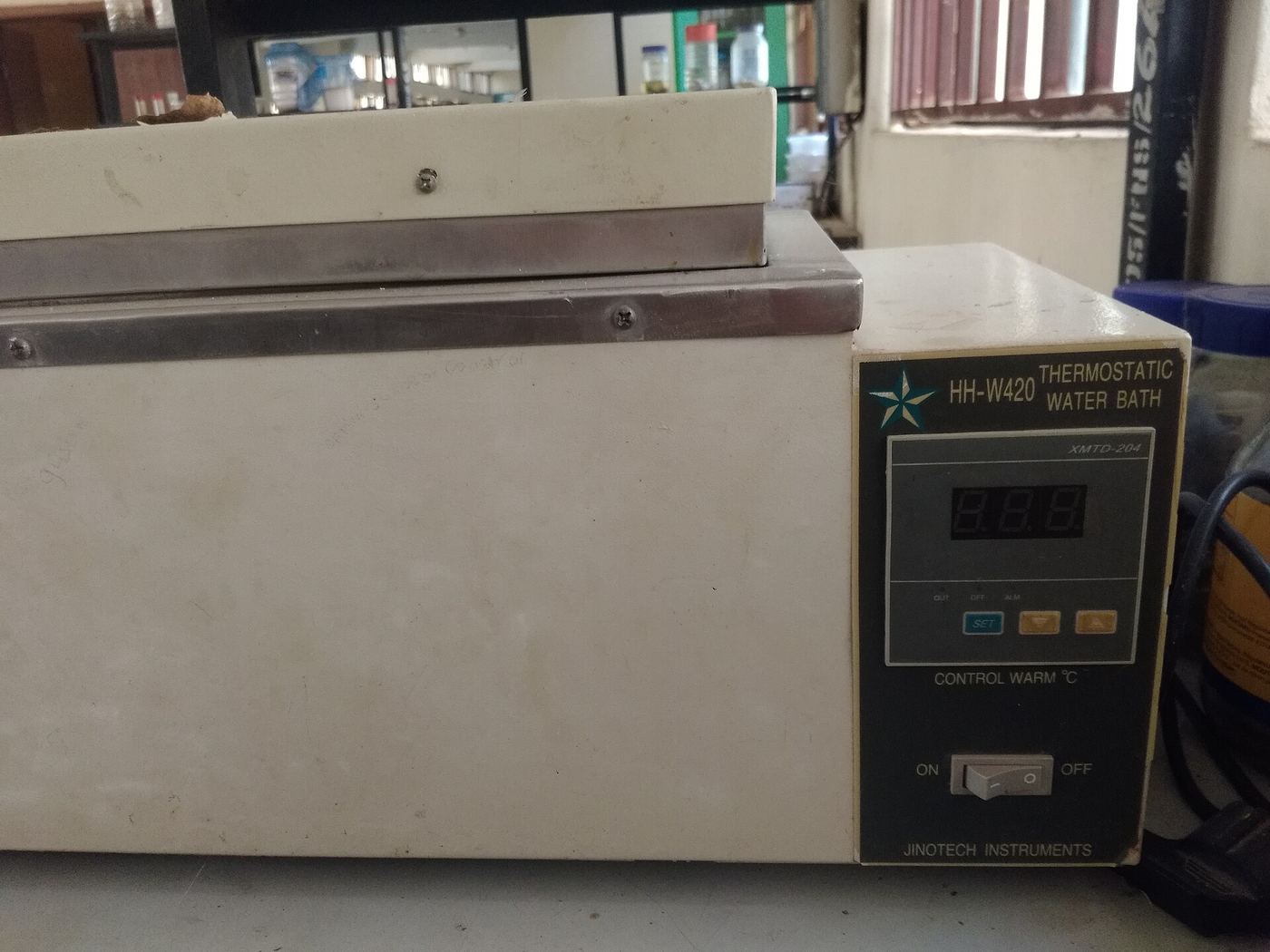
A 20 L tank at 37 °C is the case the whole maintenance argument is about, and the listing's silence on stability is the first thing to fix: ±0.1 °C and ±0.5 °C are five-fold different in span, and only one of them suits a protocol that expects 37.0. Ask too for the minimum setpoint above ambient, because a bath that starts at ambient +5 cannot do 25 °C work, and whether it has a lid, a front drain and a low-water cutout — the three features that decide whether the routine is 20 minutes or an afternoon.
A worked case: one 18 L bath at 37 °C
Assumptions: 18 L, 37 °C for cell-culture warming, used daily, in a 22 °C room.
Setpoint check: 37 °C is inside the 20 to 45 °C window, so treat it as a bath that needs a routine; ambient +5 is 27 °C, so the bath reaches 37 °C.
Pick one regime and post it, as the 2012 review advises: weekly drain, clean, descale and refill with distilled or deionised water; or monthly drain and clean plus a monthly heat to 60 °C with a one-hour hold; or a biocide after specialist advice on product and dose.
Daily and monthly checks: keep depth at or above 50 mm with the swage line as the top; wipe the lid and rim and record the action each time; and confirm 37 °C against a reference thermometer, because a ±0.5 °C tolerance means the true value can be 36.5 to 37.5.
A log that satisfies the "record the action taken" requirement would carry the date, the action (drain, heat, clean, descale, refill), the water type, initials and a reference-thermometer reading at the setpoint.
Reading the numbers on a listing
Set against a 22 °C room: ambient to 100 °C gives a lowest setpoint of 22 °C and 78 °C of headroom; ambient +5 to 99 °C starts at 27 °C with 72 °C of headroom; ambient +5 to 95 °C starts at 27 °C with 68 °C. A monthly 60 °C heat needs 38 °C of rise from that room, which every range above reaches. Above 100 °C an oil, silicone or sand bath is used instead.
Stability spans: ±0.1 °C spans 0.2 °C, ±0.2 °C spans 0.4 and ±0.5 °C spans 1.0, so the ±0.5 °C listing allows five times the span of the ±0.1 °C one. Listed presets run three on one model and four on others.
Choosing by setpoint: 37 °C sits inside the growth window; 56 °C is 11 °C above it; 60 °C needs the lid on; and anything below 27 °C in a 22 °C room is out of range for an ambient-plus-five bath.
Dates of the pages
A 2012 safety review, a 2013 fourth edition of the regulator's guidance, 2016 slides known only by file name, a 2025 university sheet, and two undated SOPs and risk assessments.
Ages as of November 2026: the review is 14 years old, the guidance 13, the slides about 10, and the 2025 sheet about 1 year 7 months. The 2012 review is the only source here with an actual measurement in it, which is worth remembering when the intervals it recommends are compared with a 2025 sheet that asks for a weekly drain instead of a monthly one.
What this article could not check
The Legionella count in the positive 37 °C bath was not published; no controlled comparison of weekly drains against monthly heating exists in the sources; the numbers behind the bead-bath limits could not be retrieved; the standards summary's calibration and uniformity figures carry no references; the regulator's part 3 text on water baths was not available; and no calibration interval from a regulator or standards body was found.
Share this article