Graduated Cylinder Class A vs Class B: Two Standards, Two Sets of Numbers
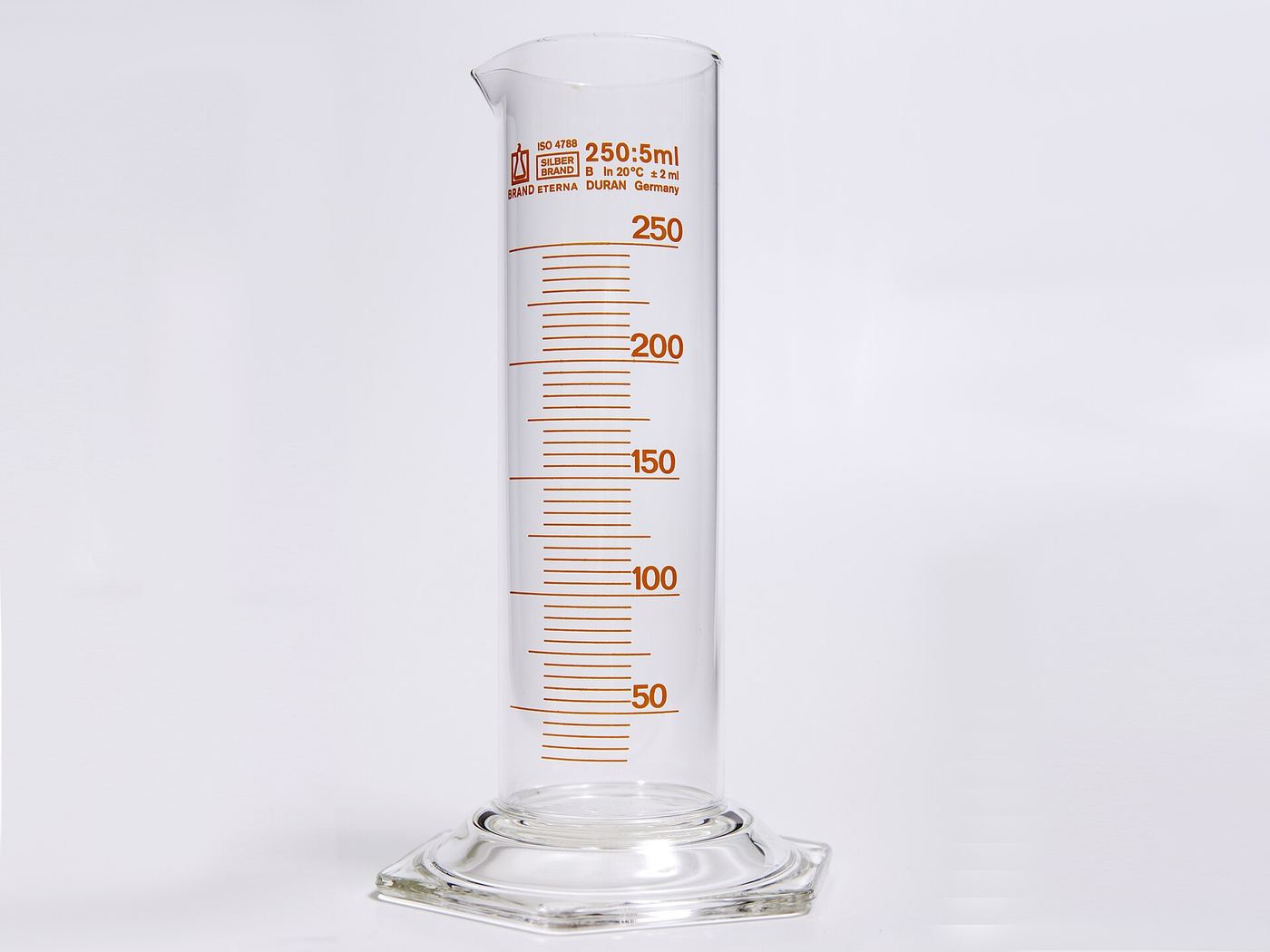
The same Class A 500 mL cylinder is ±2.00 mL if you read ASTM E1272 and ±2.5 mL if you read the ISO 4788 label on the box.
Disclosure: We may earn a commission if you purchase through links on this page, at no additional cost to you. Our selection criteria do not depend on commission; see our affiliate disclosure.
The DWK technical table, which cites ASTM E1272, gives a Class A tolerance of ±2.00 mL for a 500 mL cylinder and ±3.00 mL for a 1000 mL cylinder. BRAND, Sigma-Aldrich and Avantor list ±2.5 mL and ±5 mL for the same nominal sizes under DIN EN ISO 4788. The Weights and Measures (Local and Working Standard Capacity Measures and Testing Equipment) Regulations 1990 list ±2.0 mL and ±4.0 mL. The ratios of the ISO figures to the ASTM figures are 1.25 and 1.67. Sigma-Aldrich also sells a Class A cylinder that it describes as meeting ASTM E1272 with ±2.5 mL at 500 mL, which is 0.5 mL above the ASTM figure in the DWK table.
Three published tolerance sets
Class A tolerances in mL by nominal volume. The ASTM column comes from the DWK technical table, which cites E1272, and matches the rows visible in the E1272 abstract pages (25 mL ±0.17, 50 mL ±0.25, 100 mL ±0.50, 250 mL ±1.00, 500 mL ±2.00, 1000 mL ±3.00 and 2000 mL ±6.00). The ISO column is what BRAND, Sigma-Aldrich and Avantor print for cylinders sold to DIN EN ISO 4788. The UK column is Schedule 3 of the 1990 regulations.
| Nominal volume, mL | ASTM E1272 Class A | ASTM E1272 Class B | ISO 4788 Class A as sold | UK 1990 limit of error |
|---|---|---|---|---|
| 5 | ±0.05 | ±0.10 | ±0.05 | ±0.2 |
| 10 | ±0.10 | ±0.20 | ±0.1 | ±0.2 |
| 25 | ±0.17 | ±0.34 | ±0.25 | ±0.25 |
| 50 | ±0.25 | ±0.50 | ±0.5 | ±0.5 |
| 100 | ±0.50 | ±1.00 | ±0.5 | ±0.8 |
| 250 | ±1.00 | ±2.00 | ±1 | ±1.5 |
| 500 | ±2.00 | ±4.00 | ±2.5 | ±2.0 |
| 1000 | ±3.00 | ±6.00 | ±5 | ±4.0 |
| 2000 | ±6.00 | ±12.00 | ±10 | ±8.0 |
Ratios of ISO to ASTM Class A: 1.0 at 5, 10, 100 and 250 mL; 1.47 at 25 mL; 2.0 at 50 mL; 1.25 at 500 mL; 1.67 at 1000 and 2000 mL. Ratios of the UK figure to ASTM Class A: 4.0 at 5 mL, 2.0 at 10 mL, 1.47 at 25 mL, 2.0 at 50 mL, 1.6 at 100 mL, 1.5 at 250 mL, 1.0 at 500 mL, 1.33 at 1000 and 2000 mL. The UK page gives no temperature, no to-contain or to-deliver basis and no statement of what the limits apply to, so its column is a regulatory reference point and not a Class A figure.
ASTM E1272 states that Class B tolerances are twice Class A, that Class B cylinders need not carry a class mark, and that Class A cylinders are marked "A". The Fisher listing for a Class B 1000 mL cylinder shows ±6 mL, which is twice the ASTM Class A figure of ±3 mL. The same Fisher range shows ±12 mL at 2000 mL, ±4 mL at 500 mL and ±2 mL at 250 mL.
When one label carries several numbers
The same class name appears with different numbers on different pages.
- BRAND Class A glass to ISO 4788: 25 mL ±0.25, 50 mL ±0.5, 500 mL ±2.5, 1000 mL ±5, 2000 mL ±10.
- BRAND Class A glass with USP certificate: 25 mL ±0.17, 50 mL ±0.25, 500 mL ±2, which are the ASTM figures. A reseller lists the 1000 mL size of that USP range at ±3.
- Sigma-Aldrich Aldrich Essentials Class A "meets ASTM E 1272": 25 mL ±0.25, 50 mL ±0.50, 500 mL ±2.5, 1000 mL ±5.0. The same company lists identical figures for its "meets DIN ISO 4788" version.
- Labcomercial Class A "compliant with ISO 4788": 10 mL ±0.2, 25 mL ±0.5, 50 mL ±1, 100 mL ±1, 250 mL ±2, 500 mL ±5, 1000 mL ±10. Those values are 2.0 times the BRAND Class A figures at every size from 10 to 1000 mL.
- Fisher Class B 25 mL: ±0.34 mL on one catalogue entry, ±0.20 mL on another, ±0.4 mL on a ValueWare entry that cites E1272 Style 1.
- Fisher Class A, Eisco, 100 mL, ASTM E1272, to contain: ±0.5 mL. Fisher PYREX Class A 100 mL, to deliver: ±0.5 mL.
One pattern is worth noting from those rows: the ISO figures as sold equal half the smallest subdivision at every size from 5 to 1000 mL. A 25 mL cylinder has 0.5 mL graduations and ±0.25 mL, a 500 mL has 5 mL graduations and ±2.5 mL, and a 1000 mL has 10 mL graduations and ±5 mL. The ASTM figures fall below half a subdivision at 25, 50, 500, 1000 and 2000 mL.
Tolerance as a percentage of volume
Tolerance divided by nominal volume. ASTM Class A is 1.0 percent at 5 mL, 1.0 at 10 mL, 0.68 at 25 mL, 0.50 at 50 mL, 0.50 at 100 mL, 0.40 at 250 mL, 0.40 at 500 mL, 0.30 at 1000 mL and 0.30 at 2000 mL. ISO as sold is 1.0, 1.0, 1.0, 1.0, 0.50, 0.40, 0.50, 0.50 and 0.50 at the same sizes. UK 1990 is 4.0, 2.0, 1.0, 1.0, 0.80, 0.60, 0.40, 0.40 and 0.40. ASTM Class B doubles the ASTM Class A row to 2.0, 2.0, 1.36, 1.0, 1.0, 0.80, 0.80, 0.60 and 0.60.
The percentage is what makes the choice for a small volume. A tolerance of ±0.5 mL on a 2.0 mL volume is 25 percent, on 20 mL is 2.5 percent, on 50 mL is 1.0 percent and on 100 mL is 0.5 percent. A tolerance of ±0.17 mL on 20 mL is 0.85 percent, and ±0.20 mL on 10 mL is 2.0 percent. The first 10 percent of a 100 mL cylinder is 10 mL, which Fisher says is not graduated on its Class B line.
Water at 20 °C has a density of 0.9982 g/mL, used here as a standard value. The ASTM Class A tolerance is therefore ±0.050 g at 5 mL, ±0.100 g at 10 mL, ±0.170 g at 25 mL, ±0.250 g at 50 mL, ±0.499 g at 100 mL, ±0.998 g at 250 mL, ±1.996 g at 500 mL, ±2.995 g at 1000 mL and ±5.989 g at 2000 mL of water. The ISO figures as sold are ±0.250 g at 25 mL, ±0.499 g at 50 mL, ±2.495 g at 500 mL, ±4.991 g at 1000 mL and ±9.982 g at 2000 mL. A balance reading to 0.01 g resolves 0.010 mL of water, which is 50 times finer than the ±0.5 mL tolerance of a 100 mL Class A cylinder.
Tolerance against the graduation interval
ASTM Class A divided by the smallest subdivision: 10 mL 0.5, 25 mL 0.34, 50 mL 0.25, 100 mL 0.5, 250 mL 0.5, 500 mL 0.4, 1000 mL 0.3. JoVE states that for glassware without a known uncertainty the estimate is half the smallest increment, which is 0.5 for every size, and that a 100 mL cylinder with 1 mL marks and ±0.5 mL is recorded to the tenths place. Against that rule the ASTM tolerance is equal to the reading estimate at 10, 100 and 250 mL and smaller than it at 25, 50, 500 and 1000 mL.
What the tolerance means as meniscus height
The E1272 table lists a maximum inside diameter for each size: 15.2 mm at 10 mL, 19.3 at 25, 23 at 50, 29.6 at 100, 42.4 at 250, 50.8 at 500 and 63 mm at 1000 mL. Liquid volume per millimetre of height at those diameters is 0.181, 0.293, 0.415, 0.688, 1.412, 2.027 and 3.117 mL. A real cylinder with a smaller bore holds less per millimetre, so the heights below are lower bounds.
The ASTM Class A tolerance equals a meniscus height of at least 0.55 mm at 10 mL, 0.58 mm at 25 mL, 0.6 mm at 50 mL, 0.73 mm at 100 mL, 0.71 mm at 250 mL, 0.99 mm at 500 mL and 0.96 mm at 1000 mL. The smallest graduation spans at least 1.1, 1.7, 2.4, 1.5, 1.4, 2.5 and 3.2 mm of height. A 1 mm parallax shift in a 100 mL cylinder is 0.688 mL, which is 1.38 times the ±0.5 mL tolerance. Fisher lists the inside diameter of its Eisco Class A 100 mL cylinder, sold to ASTM E1272, as 33 mm, which is 3.4 mm above the 29.6 mm maximum in the table. The outside diameter on the same listing is 36 mm, so the wall is 1.5 mm.
NIST Good Measurement Practice 3 describes two reading options, the mid-point of the meniscus (Option A) and the top (Option B), and says Option B is referenced in a number of ISO and OIML glassware standards. It says the meniscus can look thicker than the graduation line, that eliminating parallax is very important, and that the reading uncertainty can be treated as a triangular distribution.
Cylinder against volumetric flask
The DWK catalogue, citing ASTM E288, lists Class A volumetric flask tolerances of ±0.02 mL at 10 mL, ±0.03 at 25, ±0.05 at 50, ±0.08 at 100, ±0.12 at 250, ±0.20 at 500, ±0.30 at 1000 and ±0.50 at 2000 mL. Dividing the cylinder tolerance by the flask tolerance gives 5.0 at 10 mL, 5.7 at 25, 5.0 at 50, 6.25 at 100, 8.3 at 250, 10 at 500, 10 at 1000 and 12 at 2000 mL. As a percentage of volume the flask is 0.20, 0.12, 0.10, 0.080, 0.048, 0.040, 0.030 and 0.025. John Morris Group describes the cylinder as more accurate than a beaker and less accurate than a volumetric flask, and MSE Supplies says graduated vessels use many marks, which adds uncertainty that a single-mark flask avoids.
What the standards say
ASTM E1272 covers precision and general purpose grades. Cylinders are calibrated at 20 °C, Style I is calibrated to deliver or to contain, and Styles II and III are to contain only. The glass is borosilicate that meets Type I, Class A of E438. Cylinders must stand on a surface inclined 15° from the horizontal, or 10° for 10 mL and smaller. Clause 1.1.3 allows an unlisted capacity to be called Class A when it meets the tolerance of the next smaller listed capacity. Editions exist for 2012, 2019 and 2024, and ASTM listed the 2012 edition at $77 while a reseller listed the 2024 edition at $61. ISO 4788:2005 is the title that could be verified, Laboratory Glassware — Graduated Measuring Cylinders, and ISO 384:1978 covers design principles of volumetric glassware.
Equipvia may earn a commission from qualifying purchases through this link. The link resolved to Product ID 1601692028603 during review. CPS resolution does not verify the seller's technical claims, the class, affiliate eligibility, or commission attribution. Check the actual selected variant and current terms before ordering.
"Class A" on its own is half a specification, which is the whole point of the table above: at 500 mL the same class buys ±2.0 mL under E1272 and ±2.5 mL under ISO 4788, and at 1000 mL the gap widens to ±3 against ±5. Ask which standard the marking follows and what the engraved tolerance is, size by size, then check the answer against the table. Also ask whether the cylinder is calibrated to contain or to deliver, because the two differ and E1272 Style I allows either, and whether a batch calibration certificate exists — a $1.50 cylinder can be a genuine Class A piece, but the price does not tell you which standard it was made to.
Choosing by the job
A 100 mL flask at ±0.08 mL is 6.25 times tighter than a 100 mL Class A cylinder at ±0.5 mL and 12.5 times tighter than Class B at ±1.0 mL. On the ASTM basis a 100 mL cylinder is ±1.0 percent in Class B and ±0.5 percent in Class A. A 20 mL volume in a 25 mL Class A cylinder at ±0.17 mL is ±0.85 percent, against ±2.5 percent in a 100 mL Class A cylinder, a factor of 2.9.
So the useful rule is to pick the smallest cylinder that holds the volume, not the one that is already on the bench. The 25, 50, 500 and 1000 mL sizes carry different tolerances under the same label, and the number printed on the cylinder is the number to check against the E1272 table. For anything that becomes a result — a standard, a dilution, a sample weight — a volumetric flask or a pipette is the correct tool and the cylinder is not. BRAND states that 121 °C does not leave the error limits of its plastic Class A cylinders permanently exceeded, and limits cleaning to 60 °C to preserve the markings.
What this article could not check
ISO 4788 and the full E1272 text were not read, only abstracts and tables reproduced on vendor and standards pages, so the ISO column is what sellers print rather than what the standard says. The UK 1990 column gives no temperature, basis or scope. The meniscus-height conversions and the exchange counts are arithmetic on the published diameters and densities, not measurements. ASTM E288 and E438 are known through the DWK catalogue and E1272 references only.
Share this article