Flammable Liquid Storage Cabinets: 60 against 120 Gallons, 18-Gauge Double Wall, and the 325 °F Ten-Minute Test
Sixty gallons of Class I and II, three cabinets per fire area, 1.5 inches of air between two 18-gauge skins, and a test that allows the inside to reach 325 °F while the outside hits 1300 °F.
Disclosure: We may earn a commission if you purchase through links on this page, at no additional cost to you. Our selection criteria do not depend on commission; see our affiliate disclosure.
Published figures: 60 gallons of Class I and II liquids per cabinet and 120 gallons of Class III, three cabinets per fire area, an 18-gauge double wall with a 1½-inch air space, and a fire test that allows the interior to reach 325 °F at the centre while the furnace reaches 1,300 °F. One distributor's code sheet says 120 gallons of Class I, II and IIIA combined per cabinet, and a 2016 NIH bulletin asks for at least 10-gauge steel. Below, the numbers are set side by side and the disagreements listed rather than settled.
How much one cabinet may hold
OSHA 29 CFR 1910.106 and NFPA 30 were not read in full here; the figures come from university and vendor pages that reproduce the rules.
Per-cabinet limits: 60 gallons of Category 1, 2 or 3 liquids and 120 gallons of Category 4, with no more than three cabinets in one storage area; 60 gallons of Class I or II and 120 gallons of Class III; and 120 gallons of Class I, II and IIIA together, of which no more than 60 gallons may be Class I and II.
Outside a cabinet: 10 gallons at most; 10 gallons of Class I and II combined with 25 gallons in safety cans; and, not in safety cans, 1 gallon of Class IA, 5 gallons of IB or IC, 10 gallons of Class I and II combined. In safety cans the same source allows 2.6 gallons of Class IA, 5 gallons of IB or IC, and 25 gallons combined.
The arithmetic that matters for a room: one 60-gallon cabinet is 227 L and one 120-gallon cabinet is 454 L; three cabinets at 60 gallons of Class I and II is 180 gallons per fire area; those plus 10 gallons outside is 190 gallons; three cabinets at 120 gallons of Class III is 360 gallons. Two 30-gallon drums fill a 60-gallon cabinet exactly, and one 55-gallon drum sits 5 gallons under the limit, at 208 L.
One source also caps the container: nothing larger than one gallon for Class I or II, except safety cans of two gallons. Against that cap, a 4 L bottle is 1.06 gallons and just over it, a 2.5 L bottle is 0.66 gallons and under it, a 20 L can is 5.28 gallons and far over it, and a 2-gallon safety can is 7.57 L.
A worked inventory — 24 bottles of 4 L, 8 of 2.5 L and 2 cans of 20 L, all Class I — comes to 156 L, or 41.2 gallons: 18.8 gallons under a 60-gallon cabinet and 3.8 gallons under a 45-gallon space-saver.
Where the sources disagree on capacity
- The 60-gallon limit for Class I and II is quoted by several universities; a distributor's code sheet numbered 9.5.1, also crediting the 2006 International Fire Code, says 120 gallons of Class I, II and IIIA; and a Stanford design note says the 60-gallon limit for Classes I and II was deleted from the 1998 California Fire Code.
- Cabinet counts: three per fire area or storage area in most sources; three per fire area unless more than 100 feet apart in one; three per room with each further group of three separated by 100 feet in another; and no count at all in the NIH bulletin, which points to NFPA 45 for further cabinets.
- One university adds a limit of 20 gallons of Class I per 100 square feet of laboratory area; no second source was found for it.
- Class IA per cabinet is capped at 60 gallons in one place and 30 gallons in another.
What the walls are made of
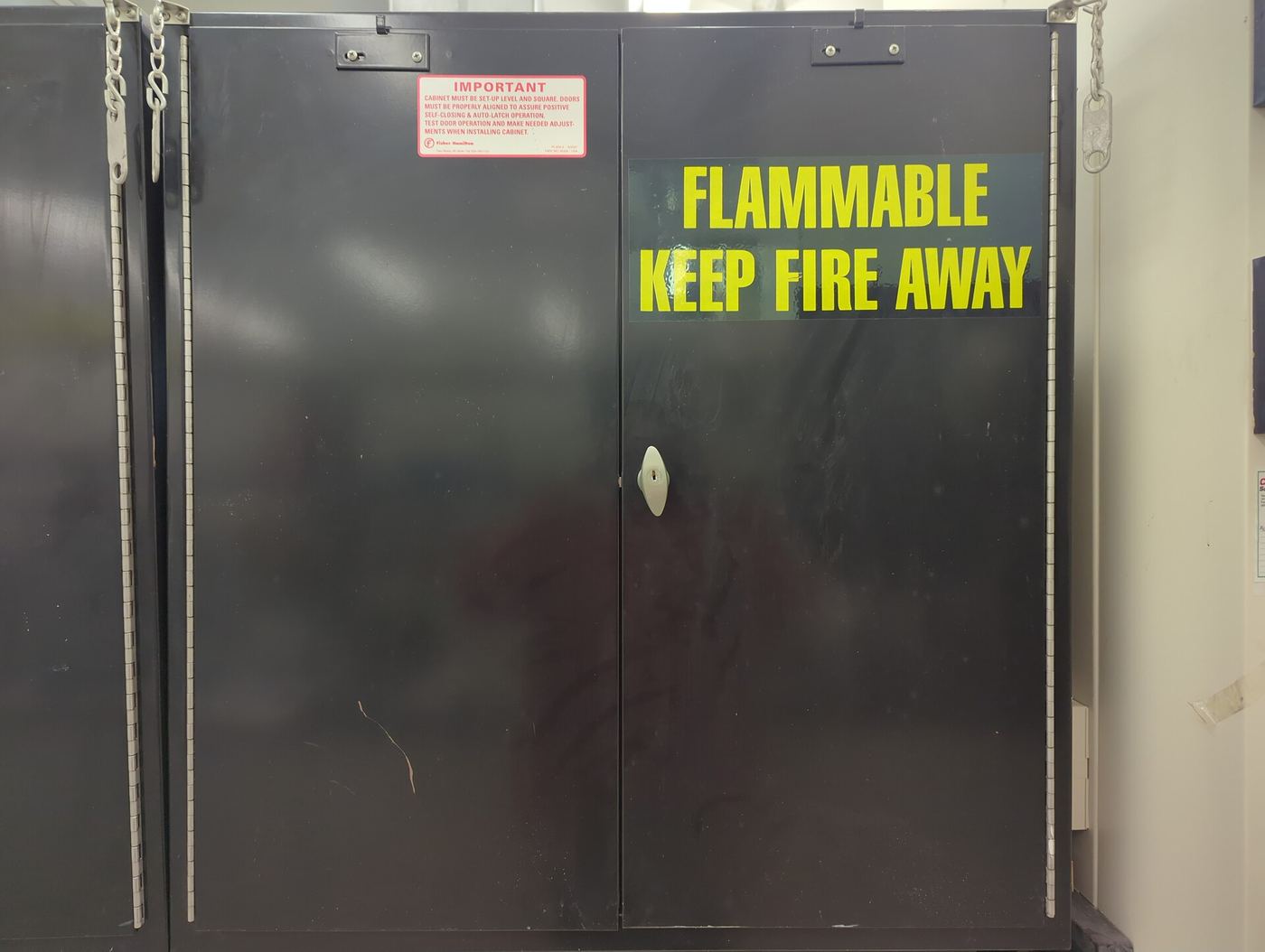
The deemed-to-comply wording, as vendors quote it: bottom, top, door and sides in No. 18 gage sheet iron, double-walled with a 1½-inch air space, joints riveted, welded or equally tight. The NIH bulletin asks for at least 10 gauge, a 3-point latch, a door sill raised 2 inches and a FLAMMABLE – KEEP FIRE AWAY label; a Canadian standard asks for a sill at least 50 mm high.
Steel thicknesses from the Manufacturers' Standard Gage: 10 gauge is 0.1345 in or 3.42 mm, 16 gauge is 0.0598 in or 1.52 mm, and 18 gauge is 0.0478 in or 1.21 mm.
So 10 gauge is 2.8 times as thick as 18 gauge, and two 18-gauge skins plus 1.5 inches of air come to 1.60 in, or 40.5 mm. A 2-inch sill is 50.8 mm, which makes the NIH and Canadian figures the same requirement. One vendor lists its 18-gauge steel as 1 mm against the table's 1.21 mm, and another sells 16-gauge at 1.52 mm.
The 10-gauge figure and the 16- and 18-gauge figures cannot all describe the same minimum. The label on the cabinet in front of you is the safer guide than any of them.
Liquid classes, for reading the limits
Flash-point bands: Class IB below 73.4 °F (23 °C); Class IC 73.4 to 100 °F (23 to 38 °C); Class II 100 or 101 to 140 °F (38 or 39 to 60 °C), with two vendor tables disagreeing on the lower figure; Class IIIA 140 to 200 °F (60 to 93.3 °C); Class IIIB 200 °F (93.3 °C) and above. One university defines a flammable liquid as one with a closed-cup flash point below 100 °F, and one vendor notes that OSHA stopped using the word combustible in 2012 in favour of Categories 1 to 4.
Band widths: Class IC spans 26.6 °F or 14.8 °C, Class II spans 40 °F or 22 °C, and Class IIIA spans 60 °F or 33 °C.
The ten-minute fire test
NFPA 30 4.3.3(a), as quoted by a cabinet maker: the interior must stay below 325 °F (162.8 °C) at the centre, 1 inch from the top, through a 10-minute test on the NFPA 251 curve, with seams tight and the door closed. The curve runs 68 °F at the start, 1,000 °F at 5 minutes and 1,300 °F at 10 minutes.
The arithmetic: 325 °F is 162.8 °C; the rise allowed from a 68 °F start is 257 °F or 143 K; the furnace gains 300 °F between 5 and 10 minutes; and inside against outside at 10 minutes is 1,300 minus 325, or 975 °F. In metric, 68 °F is 20 °C, 1,300 °F is 704 °C, and 347 °F is 175 °C. Ten minutes is 600 seconds and 90 minutes is 5,400.
The 325 °F figure is explained by one maker as sitting below the auto-ignition temperature of typical flammable liquids, quoted at 347 °F (175 °C) or above from a survey that could not be read here.
EN 14470-1: the European version
EN 14470-1 sorts cabinets into four classes — 15, 30, 60 and 90 — the minutes before the interior rises by 180 K. The 2023 edition is a product specification with a type test in Annex A, and 90 minutes is the technical standard in Germany, the Netherlands, Austria and Switzerland.
Against the US test: 90 minutes is 9 times 10 minutes; a 180 K rise is 324 °F of rise against the 257 °F the US test allows from 68 °F; and one maker writes the EN limit as 180 °C, which is an absolute temperature rather than a rise. Type 15 is 900 seconds or 1.5 times the US test, Type 30 is 1,800 seconds or 3 times, Type 60 is 3,600 or 6 times, and Type 90 is 5,400 or 9 times.
Spread evenly, the allowed rise per minute is 14.3 K for the US test, 12.0 for Type 15, 6.0 for Type 30, 3.0 for Type 60 and 2.0 for Type 90 — so Type 90 is 7.1 times slower than the US test. One cabinet is listed as approved to EN 14470-1, FM 6050 and UL 1275. A vendor guide claims a double-wall steel cabinet gives no more than three minutes before the interior reaches 180 °C, which is a vendor claim rather than a standard.
Venting, and why the bungs stay in
Venting is not required, according to five university sources, one of which cites NFPA 30 6.3.4. The vent openings on a freestanding cabinet are sealed with the metal bungs supplied, and one university states the cabinet keeps its fire rating only with them in. Another says freestanding cabinets in biomedical labs are not vented at all.
If a cabinet is vented: remove the bungs but keep the flash arrester screens, use rigid metal tubing at least as wide as the vent, take the top opening as the fresh-air inlet and the bottom to the duct; supply air to the cabinet and remove it through non-combustible pipe after calling EHS; and fit a thermally actuated damper, per the standard's recommendation. Never drill the cabinet. One 2016 bulletin requires vents to stay plugged and forbids cabinets under a fume hood, which is local policy rather than code text found here.
Doors, grounding, labels, marks
Self-closing doors are required in one source, and one maker sells the same cabinet with manual or self-closing doors. Grounding is specified by two universities, and two vendors list a ground point.
Labels: FLAMMABLE—KEEP FIRE AWAY in red lettering on a contrasting background; UL 1275 or FM 6050 as the listing to look for; NFPA 30 4.3.3 construction, a custom build tested to it, or UL 1275 as acceptable alternatives; and ULC, cUL or NFPA 30 listing for new installations in one Canadian standard.
Other rules: incompatibles in separate cabinets, and no cabinets in corridors, as far from the lab entrance as possible.
Sizes on the market
Cabinets run from 4 to 120 gallons, or 15 to 454 L. Vendors offer space-savers 18 inches deep up to 45 gallons, wall-mounts up to 24 gallons (17 and 20 gallons in one line), a 12-gallon cabinet on legs, and a 30-gallon cabinet with a 2-inch sump, bunged vents with flame arrestors and shelves for 5-gallon containers.
Converting: 45 gallons is 170 L, 24 is 91 L, 17 and 20 are 64 and 76 L, 12 is 45 L and 30 is 114 L. Three cabinets at each size give 36 gallons for 12-gallon units, 72 for 24-gallon wall-mounts, 90 for 30-gallon, 135 for 45-gallon space-savers and 180 for 60-gallon units — a five-fold spread between the smallest and largest three-cabinet totals.
Equipvia may earn a commission from qualifying purchases through this link. The link resolved to Product ID 1600547981126 during review. CPS resolution does not verify the seller's technical claims, the gauge, affiliate eligibility, or commission attribution. Check the actual selected variant and current terms before ordering.
Forty-five gallons is 170 L and sits comfortably under the 60-gallon limit for Class I and II, which is why space-savers are the common choice in a lab. What the listing has to prove is the construction: 18-gauge double wall with a 1½-inch air space, a 2-inch sill, a 3-point latch, and a UL 1275 or FM 6050 listing rather than a certificate of conformity to nothing in particular. Ask whether the bungs ship installed, because the fire rating depends on them.
Dates of the documents
The NFPA 251 test curve cited in OSHA's text dates from 1969; the California Fire Code note from 1998; a venting note from January 2010; the NIH bulletin from January 2016; one university specification revised 23 September 2022; EN 14470-1 from 2023; and a Canadian standard from June 2024.
Ages as of November 2026: the test curve is 57 years old, the venting note 16 years and 10 months, the NIH bulletin 10 years and 10 months, and the university specification 4 years. The gap between the 1998 California change and today is 28 years — which is the reason the capacity figures disagree: some pages still describe a rule that one state deleted a generation ago.
What this article could not check
The full text of OSHA 1910.106(d)(3) and NFPA 30 chapter 9 was not available, only excerpts; the source of the NIH 10-gauge figure was not found; no NFPA text settles whether cabinets may sit under a fume hood; no independent test compares a US double-wall cabinet with an EN Type 90 unit; current prices were not obtained; and neither which figure, 100 or 101 °F, starts Class II in the codes themselves, nor how the cabinet limits weigh Class IA against Class IB, could be established.
Share this article