Balance Minimum Weight: USP <41> at 2000 × SD, OIML R 76 at 20 to 100 × d, and the 0.41 d Floor
A 0.1 mg balance does not weigh a 10 mg sample to 0.1 percent. Its minimum weight is around 120 mg, which puts that sample twelve times below the line.
Disclosure: We may earn a commission if you purchase through links on this page, at no additional cost to you. Our selection criteria do not depend on commission; see our affiliate disclosure.
A balance that reads to 0.1 mg does not weigh a 10 mg sample to 0.1 percent. A&D lists a typical USP minimum weight of 120 mg for its 0.1 mg balances GX-324A and GX-324AE, so a 10 mg sample is 12 times below that line. The minimum weight of a 0.01 mg balance in the same A&D table is 20 mg, and of a 0.001 mg balance 1.8 mg. Below: the USP <41> rule, the OIML R 76 rule, the floor that stops a lucky repeatability test from claiming zero, and the A&D, Mettler Toledo and Sartorius figures.
The USP <41> repeatability rule
USP <41> assesses repeatability by weighing one test weight at least 10 times. Repeatability is satisfactory if two times the standard deviation of the weighed values, divided by the desired smallest net weight, does not exceed 0.10 percent. The desired smallest net weight is the smallest net weight the user plans to weigh on that balance. A&D writes the condition as (2 × S.D.) / smallest net weight ≤ 0.10 percent. Rearranged, minimum weight is at least 2000 times the repeatability S.D. American Pharmaceutical Review, Sartorius and Mettler Toledo all give the same factor of 2000, and Mettler writes it as 2 divided by 0.1 percent.
The arithmetic is 2 / 0.001 = 2000. A balance with a repeatability S.D. of 0.1 mg has a minimum weight of 200 mg; with 0.01 mg it is 20 mg; with 0.001 mg it is 2 mg.
The test weight must be within the operating range of the balance. The USP text states that the S.D. is virtually independent of sample mass within the balance's capacity, so the test weight does not have to be small. News-Medical repeats the point and adds that the test load must not be below the minimum weight.
The 0.41 d floor
If the measured S.D. is below 0.41 d, then 0.41 d is used instead, so the minimum weight becomes 2000 × 0.41 d = 820 d. Sartorius gives the reason: a measured S.D. of 0 would give a minimum weight of 0 g. At d = 0.1 mg the floor is 82 mg; at d = 0.01 mg it is 8.2 mg; at d = 0.001 mg it is 0.82 mg.
The floor by readability:
- d = 0.1 mg: 82 mg
- d = 0.01 mg: 8.2 mg
- d = 0.001 mg: 0.82 mg
- d = 0.001 g: 0.82 g
- d = 0.01 g: 8.2 g
The Sartorius annex example is an MCA224S balance with d = 0.1 mg. The OIML minimum for it is 10 mg. The smallest possible USP value is 82 mg, which is the floor. The table lists a typical USP value of 100 mg and a recommended value of 250 mg. Those four figures stand at 10, 82, 100 and 250 mg, and the last is 25 times the first.
OIML R 76-1 minimum load
Sartorius reproduces the OIML R 76-1:2006 minimum load as a multiple of the scale interval, set by accuracy class and verification interval e.
| Accuracy class | e | n | Minimum load |
|---|---|---|---|
| I, special | e ≥ 0.001 g | n ≥ 50,000 | 100 d |
| II, high | 0.001 g to 0.05 g | 100 to 100,000 | 20 d |
| II, high | e ≥ 0.1 g | 5,000 to 100,000 | 50 d |
| III, medium | 0.1 g to 2 g | 100 to 10,000 | 20 d |
| III, medium | e ≥ 5 g | 500 to 10,000 | 50 d |
| IIII, ordinary | e ≥ 5 g | 100 to 1,000 | 10 d |
Sartorius adds that for balances with d below 0.1 mg, n may be below 50,000. The OIML minimum load is fixed by class and scale interval, so it needs no measurement at the installation site. It is defined only for models approved for legal metrology. USP depends on a repeatability test that can change each time it is run, which is the practical difference between the two approaches.
In mg, for a class I balance at 100 d: d = 0.1 mg gives 10 mg, d = 0.01 mg gives 1 mg, d = 0.001 mg gives 0.1 mg. For a class II balance at 20 d: d = 0.01 mg gives 0.2 mg and d = 0.1 mg gives 2 mg.
Typical USP minimum weights, A&D
The A&D table lists capacity, repeatability S.D. with the test load, and the typical minimum weight. The last column is the minimum weight divided by d.
| d | Model | Capacity | S.D. | Min. weight | Min. / d |
|---|---|---|---|---|---|
| 0.001 mg | BA-6TE, BA-6E | 6.2 g | 1 µg at 1 g | 1.8 mg | 1,800 |
| 0.001 mg | BM-5 | 5.2 g | 1.2 µg at 1 g | 2.0 mg | 2,000 |
| 0.001 mg | BM-20 | 22 g | 2.5 µg at 1 g | 3.0 mg | 3,000 |
| 0.01 mg | BA-225, BA-225TE | 220 g | 0.015 mg at 50 g | 20 mg | 2,000 |
| 0.01 mg | BM-252 | 250 g | 0.03 mg at 100 g | 20 mg | 2,000 |
| 0.01 mg | GH-252 | 101 g | 0.03 mg | 24 mg | 2,400 |
| 0.01 mg | GR-202 | 42 g | 0.02 mg | 30 mg | 3,000 |
| 0.1 mg | BM-500 | 520 g | 0.2 mg | 120 mg | 1,200 |
| 0.1 mg | GX-324A | 320 g | 0.1 mg at 200 g | 120 mg | 1,200 |
| 0.1 mg | HR-250A | 252 g | 0.1 mg | 140 mg | 1,400 |
| 0.001 g | GX-203A | 220 g | 0.001 g | 1.4 g | 1,400 |
| 0.01 g | GX-2002A | 2,200 g | 0.01 g | 14 g | 1,400 |
The range of the last column across the full A&D table is 1,200 to 3,000. Every entry lies above the OIML class I figure of 100 d and above the 820 d floor, by a factor of 1.5 to 3.7 over the floor. A&D labels the values typical, and the S.D. behind them is a manufacturer figure, not a measurement on a particular balance in a particular room.
Two A&D lines deserve a second look. BM-500 has d = 0.1 mg and S.D. = 0.2 mg, which is 2 d, and its minimum weight is 120 mg — below the 2000 × 0.2 mg = 400 mg that the S.D. alone would give. A&D does not explain this on the page read, so the 120 mg may be based on a different S.D. than the 0.2 mg listed. The same gap appears at GX-324A below.
Sources disagree on 2σ and 3σ
Rice Lake, before the revision: 3 × S / mass ≤ 0.10 percent. Rice Lake, after: 2 × S / mass ≤ 0.10 percent. Mettler, citing USP 37, writes 3 × S.D. of at least 10 weighings / amount weighed ≤ 0.001. A copy of the 2σ text carries an implementation date of 1 July 2014. The date of the change in the pages read was not confirmed.
The difference is a factor of 1.5. With S = 5 µg the 2σ minimum is 10 mg and the 3σ minimum is 15 mg; with S = 0.1 mg it is 200 mg against 300 mg. A lab that inherited a 3σ worksheet will find its minimum weight overstated by half.
Accuracy, the second USP test
Accuracy is satisfactory when the reading does not deviate by more than 0.10 percent of the test weight. A&D gives the test weight range as 5 to 100 percent of the capacity and states that the weight's maximum permissible error or calibration uncertainty must not exceed one third of the 0.10 percent limit, which is 0.033 percent. For a 200 g test weight the reading limit is 200 mg and the weight limit 66.7 mg; for a 5 percent weight on a 320 g balance, 16 g, the reading limit is 16 mg and the weight limit 5.3 mg.
What the minimum weight does to a weighing
Sartorius gives two relative figures for an absolute uncertainty of 0.1 mg: on 100 g it is 0.0001 percent, on 1 mg it is 10 percent. The relative figure is 0.1 mg divided by the sample mass, which gives 1 percent at 10 mg, 0.1 percent at 100 mg and 0.01 percent at 1 g.
Sartorius also gives a variability example. A test with S = 5 µg gives 2000 × 5 µg = 10 mg; a later test with S = 8 µg gives 16 mg. The difference is 6 mg, or 60 percent, which is why Sartorius recommends a fixed smallest net weight based on the process requirement rather than the calculated minimum.
The net-weight rule applies too. Sartorius states that weighing 0.5 g of substance in a 50 g vessel is not permitted when the minimum is 1 g, because differential weighing does not bypass the minimum. The vessel mass is not part of the net.
A third way: the EURAMET cg-18 uncertainty
The Sartorius paper also gives a calculation from the EURAMET cg-18 guidance. With Ugl(W) = 0.00024 g + 3.88 × 10⁻⁶ × R, a 1 percent process accuracy needs at least 0.0242 g; with a safety factor of 2 the minimum is 0.0485 g. Sartorius suggests setting 25 mg in practice rather than 24.2 mg.
Three methods applied to analytical balances: OIML class I at d = 0.1 mg gives 10 mg; the USP floor at d = 0.1 mg gives 82 mg; the EURAMET example in the Sartorius paper for 1 percent gives 24.2 mg, or 48.5 mg with the safety factor. The Sartorius paper does not state which balance the EURAMET example describes, so the third line is not the same instrument as the first two.
Equipvia may earn a commission from qualifying purchases through this link. The link resolved to Product ID 1601375088108 during review. CPS resolution does not verify the seller's technical claims, the readability, affiliate eligibility, or commission attribution. Check the actual selected variant and current terms before ordering.
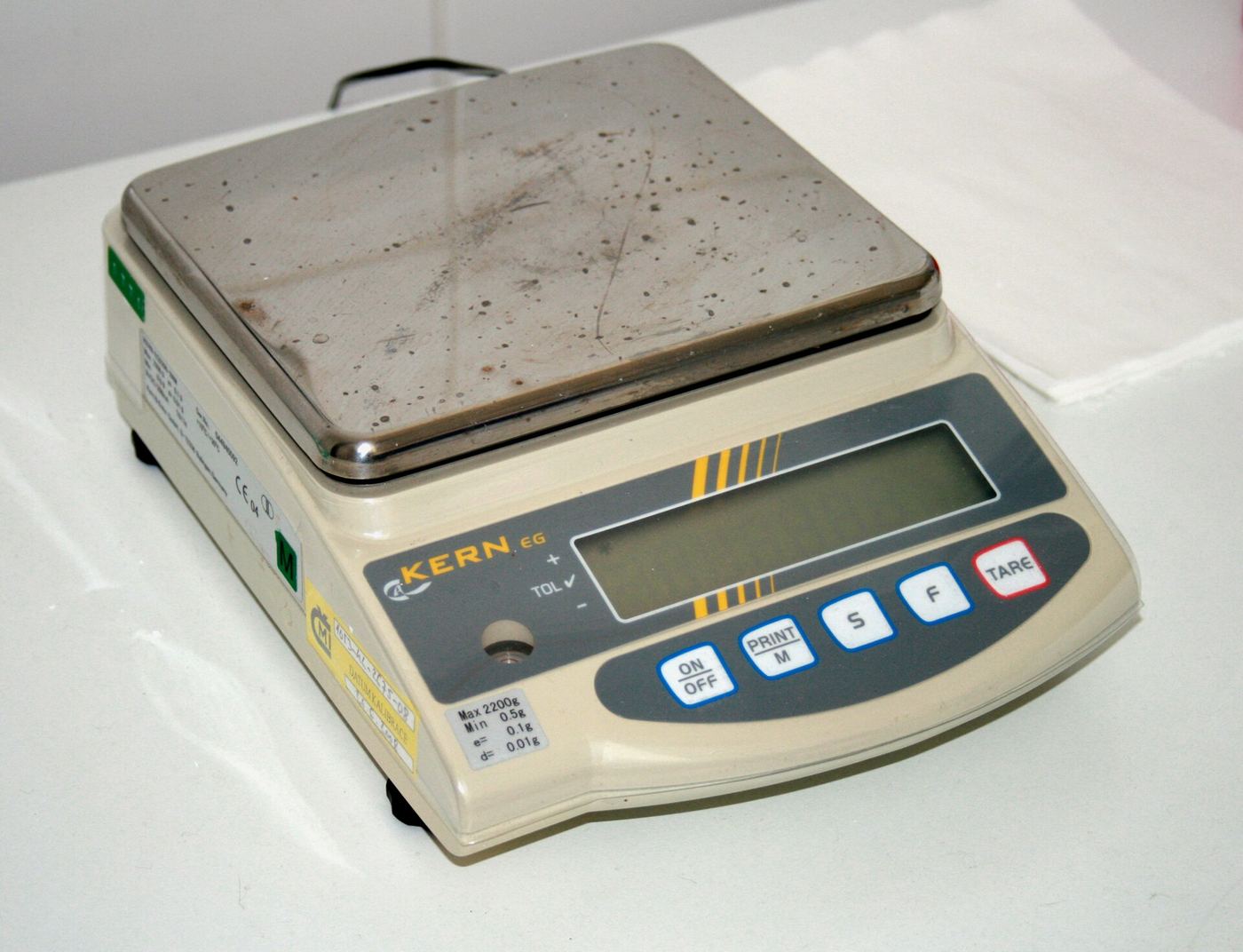
Readability is stated at 0.1 mg, and that single number already sets a floor: 820 d is 82 mg, so no FA-N balance can be claimed below 82 mg whatever its repeatability test shows, and the A&D equivalents in that class land at 120 to 140 mg. What the listing omits is the repeatability standard deviation, which is the figure that actually decides the minimum weight. Ask for it with the test load, ask whether the model carries OIML approval, and note that the range runs to 320 g — capacity bought beyond your heaviest sample usually costs readability rather than adding it.
The S.D. a given smallest sample demands
Required S.D. = smallest net weight / 2000. A 1 mg sample needs S ≤ 0.5 µg; 10 mg needs ≤ 5 µg; 20 mg needs ≤ 10 µg; 100 mg needs ≤ 50 µg; 1 g needs ≤ 0.5 mg. Against the A&D figures: BA-6E at 1 µg at 1 g passes a 10 mg sample (1 µg ≤ 5 µg) while BA-225 at 15 µg at 50 g fails it; GX-324A at 100 µg fails a 100 mg sample, which needs 50 µg or better.
Choosing a balance from the smallest sample
From the two formulas, the smallest net weight is at least 2000 × S, and S is at least 0.41 d, so the smallest net weight is at least 820 d. Divide the smallest sample you plan to weigh by 820 to get the largest d that can pass.
- Smallest sample 10 mg: d ≤ 0.0122 mg, so a 0.01 mg balance if its S.D. sits at the floor.
- Smallest sample 100 mg: d ≤ 0.122 mg, so a 0.1 mg balance if its S.D. is near 0.41 d.
- Smallest sample 1 mg: d ≤ 0.00122 mg, so a 0.001 mg balance.
- Smallest sample 1 g: d ≤ 1.22 mg.
In the A&D table the typical minimum is 1,200 to 3,000 d, not 820 d. At the typical 1,400 d level the same rule gives d ≤ smallest net weight / 1,400: for a 100 mg sample that is 0.071 mg, which excludes a 0.1 mg balance such as the HR-250A at 140 mg. That is the whole argument for measuring repeatability on the balance in its own room rather than trusting the datasheet: the datasheet figure is often twice as optimistic as the floor.
Sample size against the A&D 0.1 mg figures
For a GX-324A with a listed minimum weight of 120 mg and S = 0.1 mg, minimum weight over sample mass is 12.0 at 10 mg, 2.4 at 50 mg, 1.2 at 100 mg, 1.0 at 120 mg, 0.48 at 250 mg and 0.12 at 1 g. The value 2 × S / m at S = 0.1 mg is 2.0 percent at 10 mg, 0.4 percent at 50 mg, 0.2 percent at 100 mg and 0.1 percent at 200 mg. At the listed S = 0.1 mg the 0.10 percent limit is reached at 200 mg, not at 120 mg — the same gap as the BM-500 line above, and a reminder that a manufacturer's typical minimum and the 2000 × S formula can disagree by a factor of nearly two.
What this article could not check
The full current text of USP <41> and <1251> with the 2019 and later changes in one place was not available, nor a published minimum weight for the same balance under both USP and OIML, nor an independent test of a balance's minimum weight against the manufacturer's typical value, nor the Mettler Toledo model-by-model values. The A&D table is a manufacturer table, the OIML table is reproduced by Sartorius, and the 2σ and 3σ statements come from vendor summaries.
Share this article