Peristaltic Pump Tubing: Material, Wall Thickness and Replacement
The wall thickness sets how hard the roller squeezes, and it is the one dimension you cannot vary. The bore sets the flow. Choosing by part number skips both.
Disclosure: We may earn a commission if you purchase through links on this page, at no additional cost to you. Our selection criteria do not depend on commission; see our affiliate disclosure.
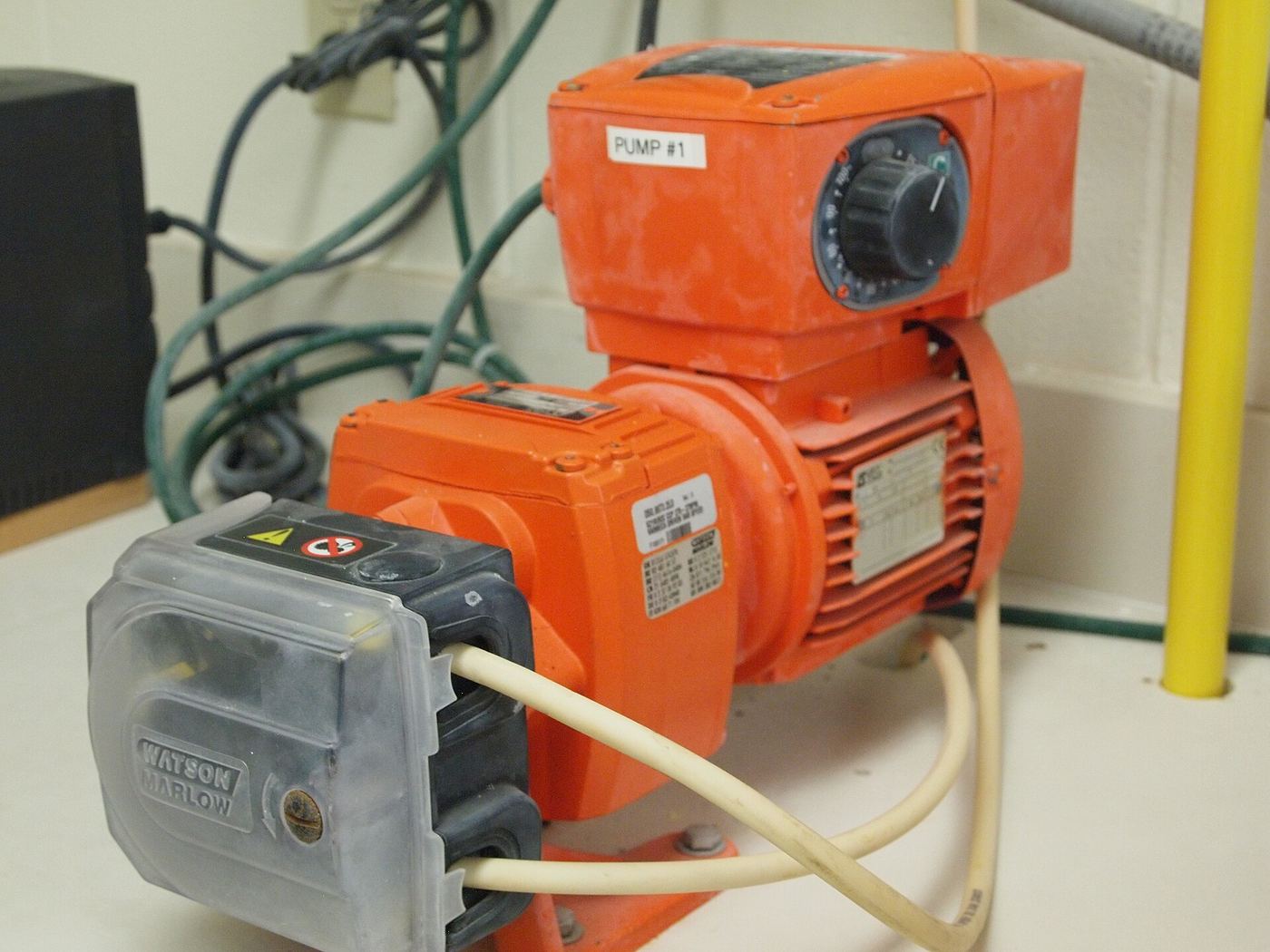
Watson-Marlow's bioprocess durability test gives a decent picture of what a tube goes through: 6.4 mm bore, 2.4 mm wall, 220 rpm, 2 bar, running until the tubes give out. Every roller pass crushes the wall flat. Because the tube is also the only wetted part, it ends up as the wear item, the chemical barrier and the flow calibration in one piece of extrusion. A pump can look fine while the tube has shifted the flow, absorbed some of the analyte or shed particles.
Reordering by part number skips three questions. Does the wall fit the head? Does the polymer interact with the fluid? How would you know the tube is finished? Those are the sections below. Most figures come from tubing and pump sellers and are attributed to them.
Start with the head: bore, wall and the 3:1 limit
For a given pump head, the wall thickness is the dimension that cannot move. The head sets a fixed gap between roller and track, and the tube wall decides how much it is squeezed. The bore, by contrast, mostly sets how much liquid each roller pass traps. A Watson-Marlow engineer writing in Machine Design puts it that way: bore size determines flow rate, and wall thickness affects pump efficiency. The same article advises keeping the bore-to-wall ratio at 3:1 or lower, and picking the largest bore the pump can take.
Two worked examples show how that looks in practice. The Watson-Marlow test conditions above work out to a bore-to-wall ratio of about 2.7 by arithmetic. An explainer on FIRGELLI's site cites 4.8 mm bore with 1.6 mm wall as standard for benchtop lab heads, which is exactly 3.0. Neither is a rule for your head; both show the same order of magnitude.
Occlusion, the amount of squeeze, is where sources talk past each other. The Wikipedia article on peristaltic pumps defines it as a percentage of twice the wall thickness and gives 10 to 20 % as typical, higher for softer tubing. The FIRGELLI explainer defines it as a ratio, (tube OD minus roller gap) divided by twice the wall, and says 1.0 to 1.2 suits silicone or PharMed BPT. Those are not the same quantity, and the second definition could not be verified against a manufacturer manual. The practical lesson is dull but useful: when someone quotes an occlusion number, find out which formula they used before comparing it with your pump.
The direction of the trade is clearer. A US patent filed to vary occlusion in a pump, describing the prior art, says tube life falls as occlusion rises while the ability to build pressure or vacuum rises with it. Blue-White's pump-wear article adds that larger diameters and thinner walls generally reduce life, and that system pressure is probably the most influential factor. It also warns that under-squeezing lets fluid slip backward past the roller when the pump works against higher pressure than recommended.
Hardness: a narrow band
One tubing whitepaper suggests choosing between 50 and 65 Shore A for peristaltic duty. Distributor listings fall around that band: VWR lists food-grade PVC at 65A and wire-reinforced PVC at 70A, and Fisher lists a platinum-cured silicone at 50A. Verderflex notes that its Verderprene and silicone have better suction lift than similar sizes of Tygon or Viton, which fits the idea that softness and recovery help priming. If your pump has to lift from a low reservoir, that is worth a line in the comparison.
The material families, briefly
Silicone is soft and recovers well, but it is also the gas-permeable one. Fisher's listings give carbon dioxide permeability of 25,147 for a platinum-cured silicone against 76 to 79 for Viton, in whatever units the listing uses, which by division is a gap of over 300 times. Darwin Microfluidics adds that peroxide-cured silicone can extend life by up to 40 %, while platinum-cured grades offer better biocompatibility, and that high-performance precision tubing typically gives 20 to 30 % more service life than standard precision tubing. Verderflex points out that Tygon and Viton cost more to produce than silicone or Verderprene because of their raw materials. Thermoplastic elastomers, particularly the SEBS-based ones, are growing in single-use bioprocessing because they weld, according to a Watson-Marlow article, and that is a reason to pick them for sterile connections more than for wear. Viton is for aggressive chemicals, not for endurance.
Matching material to fluid: charts, then a soak test
Every major supplier publishes a compatibility chart, and every chart carries a disclaimer. Cole-Parmer's version warns that even tubing which passes an immersion test can fail when temperature, pressure or concentration change. VWR's guide calls its summaries guidelines only, and defines its best rating as no damage after 30 days of constant exposure. Heidolph's matrix adds that all its information is not guaranteed to be correct.
The charts also do not always agree, because they test different compounds and call different results by different letters. Here are three fluids from two sources.
| Fluid | Silicone | PharMed | Tygon (standard) | Viton |
|---|---|---|---|---|
| Methanol, Heidolph | B, good | A, excellent | D, unsuitable | D, unsuitable |
| Methanol, Darwin Microfluidics tables | A, no effect | not shown | Tygon E-LFL: X, severe | not shown |
| Acetonitrile, Heidolph | D, unsuitable | C, conditional | D, unsuitable | D, unsuitable |
| Methyl ethyl ketone, Heidolph | D, unsuitable | D, unsuitable | D, unsuitable | D, unsuitable |
Silicone's methanol rating differs by one grade between the two sources, and Tygon is a family, so Heidolph's standard grade and Cole-Parmer's E-LFL are not interchangeable anyway. Treat these as a screen. Verderflex suggests the confirming step: soak a piece in your fluid and measure changes in hardness, weight, volume and tensile strength. It adds that such a test gives an indication of chemical resistance, not a guarantee.
One thing the chart cannot show is which compound is being absorbed.
What the tubing does to the sample
Elastomer tubing is not inert. It can take up the analyte, give up its own additives, or do both.
Fluoropolymer-lined tubing is the usual benchmark. A 2001 paper in the PDA Journal of Pharmaceutical Science and Technology by Bahal and Romansky recalls earlier work in which as much as 100 % of propylparaben was lost within 24 hours in Tygon, Clearflo or Silastic tubing, while Teflon FEP showed no sorption loss. A related abstract reports that silicone showed the highest sorption of preservatives, up to 64 % after 120 hours in some tubings, and that refilling with fresh solution after a week still produced extensive sorption. Benzalkonium chloride was not sorbed. That last point is a useful reminder that sorption depends on the compound, not just the tube.
Groundwater sampling literature is older and bigger. A 1997 paper in Ground Water Monitoring and Remediation tested twenty polymeric tubings with eight organic solutes. Among flexible tubings, a fluoroelastomer and a vinylidene fluoride–hexafluoropropylene copolymer sorbed the least, while polyurethane, polyamide, flexible PVC, polyester-lined PVC and silicone-modified TPE leached the most constituents. A US Army cold-regions laboratory review of this literature reports one study where benzene dropped by about 55 % in an hour with flexible PVC and not at all with rigid PVC, and others where organics read 8 to 15 % lower after silicone than after Teflon. These are quoted from that review's summary rather than the original studies, so treat the figures as indicative.
The evidence is not one-directional. A conference presentation by Robert Hamel compared silicone and Viton tubing in a low-flow sampling set-up with polycyclic aromatic hydrocarbons at 100 mL/min, and reported no significant difference in recovery. The recoveries were far from perfect for either tube: benzo(g,h,i)perylene came back around 60 to 63 % and the methylnaphthalenes around 70 to 72 %. Read together, those results say that swapping silicone for Viton is not by itself a fix for hydrophobic losses.
A 2023 Applied Sciences study put 1,000 cm² of each of six materials into 2 L of water carrying 100 ng/L of each estrogen. Tygon S3 took up considerable amounts of estrone, estradiol and ethinylestradiol, and styrene butadiene rubber took up a lot of estrone. PTFE and PVDF were in the same test, but the page read for this article did not give their numbers, so none are quoted. At those concentrations, whatever the tube holds back is a large share of what you meant to measure.
Spallation: the particles you did not add
Each roller pass compresses the tube to a seal, and bits of the wall come off. Saint-Gobain's technical note calls it spallation and says the rate and the particle size vary greatly even within a material family: not every PVC sheds like every other PVC, and the same holds for silicones. Liu, Faria and Leonard (Artificial Organs, 2017) counted particles down to 0.6 µm in three PVC tubings and one co-extruded PVC/polyurethane tubing. Mean particle size was 0.83 ± 0.03 µm for every PVC type. The PVC/polyurethane tube shed particles about twice that size but roughly ten times fewer of them than the cleanest PVC. The work was done for blood circuits, so the counts do not carry over to a solvent line. What carries over is that a large number of the particles are under 2 µm, which older counters were likely to miss.
On a chemistry bench this tends to appear as a waxy film on the rollers, which Saint-Gobain says is easily mistaken for grease, or as specks on a downstream filter. If the stream feeds something particle-sensitive, ask for the spallation method and not just the claim. Saint-Gobain's PharmaPure datasheet shows what a method statement looks like: 1/16 in ID tubing, two six-roller heads at 300 rpm, room temperature, particles measured by flow imaging.
Life: the hour depends on the test
Darwin Microfluidics gives the common convention for tube life: time to failure, or a 50 % drop in flow, whichever comes first. Its illustrative table puts Norprene and PharMed BPT at about 10,000 hours at 50 rpm and about 1,000 at 600 rpm, a tenfold penalty for a twelvefold speed increase by arithmetic. Its general range is a few hundred hours to several thousand, depending on material, speed, pressure and chemistry. In Watson-Marlow's own test (220 rpm, 2 bar, three weldable TPE grades), one tubing held its flow and the others lost it from the start and kept losing it. The authors work for the pump maker and tested their own grades, so take the flow-stability point and not a brand ranking.
Another pump supplier, Grayline, ran six materials through two tests. In a short continuous run, everything except Viton stayed within 3 % of starting flow, which means cheap PVC matched silicone. When the pump started and stopped so that the roller parked on the same spot, silicone was the only tubing with steady flow, which the company ties to its compression set. Viton wore badly under dynamic load. Fisher's own Viton listing says limited pumping life, which agrees. Viton earns its place by what it resists, not by how long it runs.
New tubing needs breaking in. The Machine Design article says flow falls during early use before it settles, and suggests at least an hour of running in before you calibrate for precise work.
Equipvia may earn a commission from qualifying purchases through this link. The link resolved to Product ID 1600457199736 during review. CPS resolution does not verify the seller's technical claims, the dimensions, affiliate eligibility, or commission attribution. Check the actual selected variant and current terms before ordering.
For tubing the variant list is the specification, and a "thin wall" range is the wrong end of it. Ask for the bore and wall of each size in millimetres, not as a nominal family name, and check the wall against the gap in your pump head before ordering a roll. Silicone also has the highest gas permeability of the common materials, which matters if the fluid is oxygen-sensitive or the run is long. A food-grade claim covers the polymer's approval, not its pumping life or its dimensional tolerance.
When to replace it: a routine, not a published interval
None of the sources gives a general interval. A workable routine goes like this, with the numbers as an illustration. After the one-hour run-in, pump 100 mL into a measuring cylinder at your working speed and note the time. Repeat every week or so, or every 50 hours at speed if you track that. When the time stretches past what your method tolerates (for a 5 % flow tolerance, about 105 s against a baseline of 100 s), change the tube. Do not wait for a leak. If the head lets you advance the tube a few centimetres, doing so moves the crush point onto fresh wall, and a section that looks flat, shiny or glazed should be cut out regardless. Log hours at speed rather than calendar days, since a speed change moves life by an order of magnitude and the date moves it by nothing.
Reading the symptoms
Flow sagging steadily through a run usually means the tube is losing its spring, or the occlusion is too light for the back-pressure. A tube that dies early while looking clean points the other way: too much squeeze, or more pressure than it was sized for, which are the two things the patent and one pump maker's article both blame. Tacky, swollen or stiffened tubing is a chemistry mismatch, and a soak test would have caught it. If flow is steady but analyte recovery is low, suspect sorption and change the polymer rather than adjusting the pump. Specks on a downstream filter point at spallation.
Share this article